
During the Napoleonic Wars (1803–1815), Mauritius, then known as Isle de France, became a key French naval base in the Indian Ocean. Positioned strategically, it allowed French forces to disrupt British trade routes to India and beyond. The conflict peaked with the Battle of Grand Port in August 1810, where the French secured their only naval victory over the British during this era. However, by December 1810, the British launched a large-scale invasion, capturing the island and renaming it Mauritius.
Today, you can experience this history through monohull sailing tours. These tours navigate historic waters, visit landmarks like Île de la Passe and explore shipwrecks from the era. Guided by local experts, they combine hands-on sailing with stories of naval strategies and life at sea. For history enthusiasts, these tours offer a chance to connect with the past while enjoying the serene beauty of Mauritius.
Key highlights:
- Battle of Grand Port (1810): A rare French naval victory commemorated on the Arc de Triomphe.
- British Invasion (1810): Led to the capture of Isle de France, marking the end of French control.
- Modern Sailing Tours: Explore historic routes, coral reefs, and shipwrecks from the Napoleonic era.
For an immersive experience, Blue Safari Mauritius offers private sailing tours starting, blending history with modern comfort.
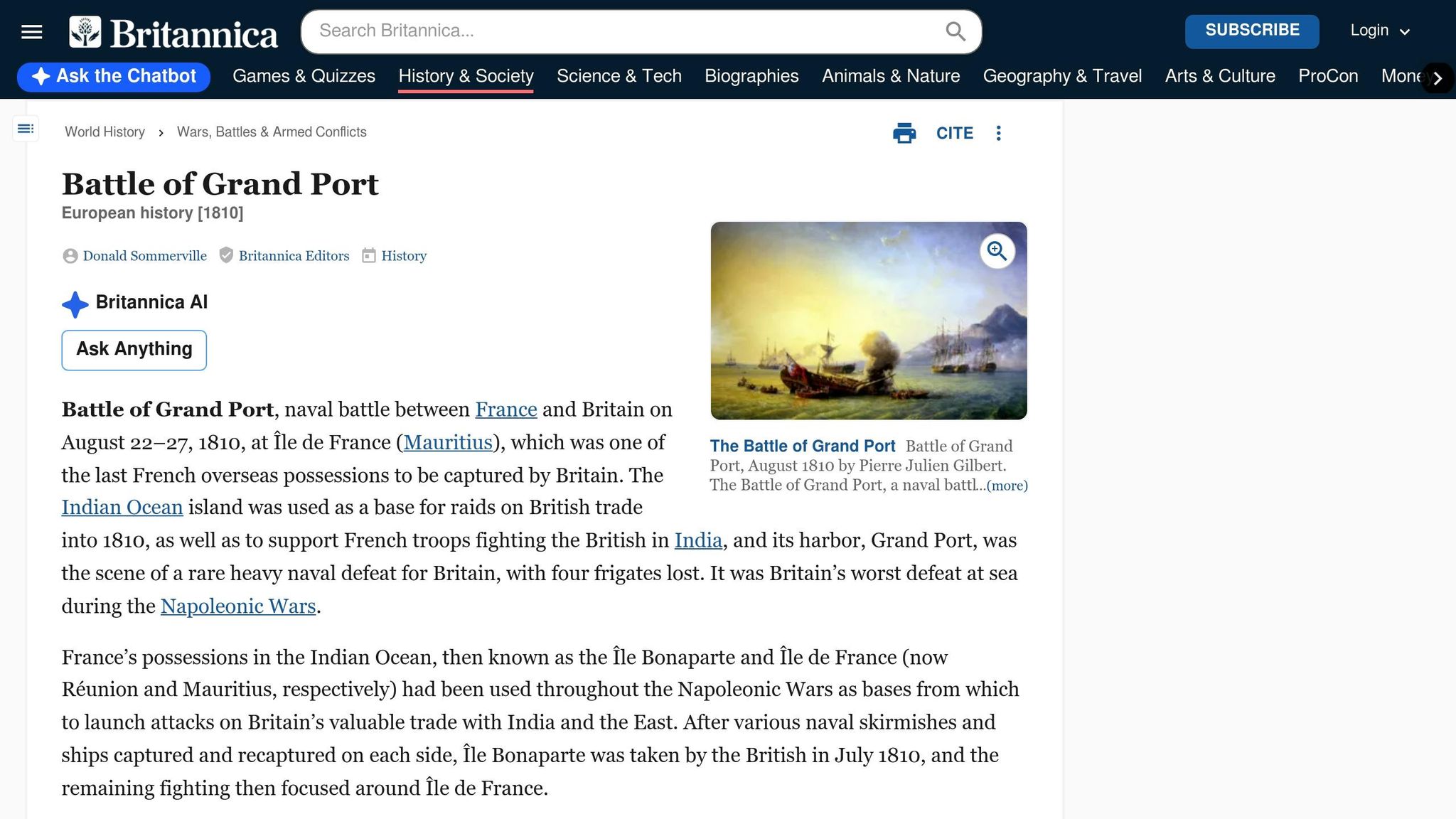
Battle Of Grand Port
sbb-itb-3563db6
The Napoleonic Campaigns in Mauritius: Naval Events and Battles
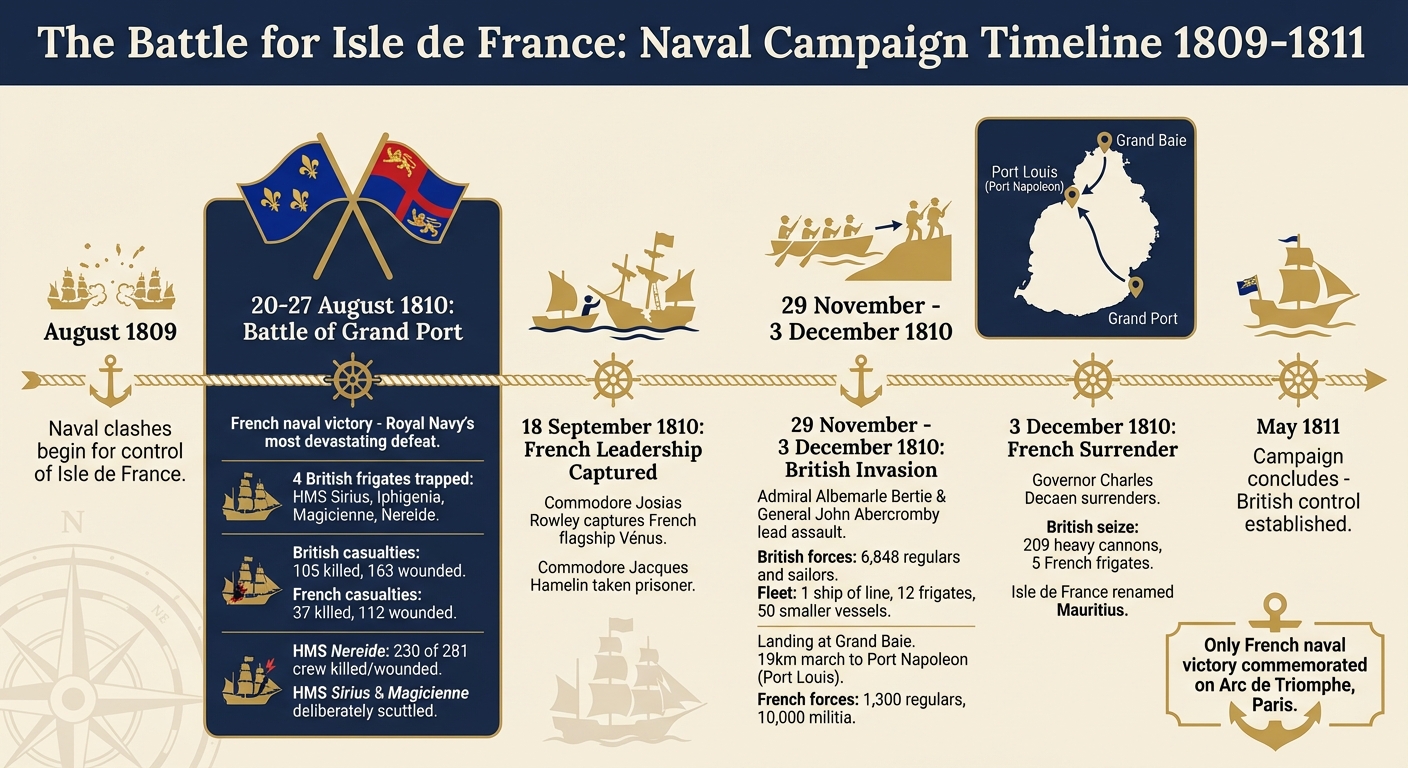
Battle of Grand Port Timeline: French Naval Victory 1810
The Battle for Isle de France: 1809–1811
Between August 1809 and May 1811, a series of fierce naval clashes decided the fate of Isle de France. Among these, the Battle of Grand Port, fought from 20th to 27th August 1810, stands out as the Royal Navy’s most devastating defeat during the Napoleonic Wars. Captain Samuel Pym’s fleet of four British frigates – HMS Sirius, Iphigenia, Magicienne, and Nereide – fell victim to a cunning French tactic. By removing safe-route buoys, the French forced the British ships into coral reefs. HMS Sirius and HMS Magicienne were deliberately scuttled to prevent capture, while HMS Nereide suffered catastrophic losses, with 230 out of 281 crew members killed or wounded. In total, British casualties amounted to 105 killed and 163 wounded, while the French sustained 37 deaths and 112 wounded.
Despite this setback, the British regrouped. On 18th September 1810, Commodore Josias Rowley captured the French flagship Vénus and took French naval commander Commodore Jacques Hamelin prisoner, striking a blow to French leadership. The decisive moment came between 29th November and 3rd December 1810, when Admiral Albemarle Bertie and General John Abercromby launched a large-scale amphibious assault. Backed by 6,848 regulars and sailors, supported by 1 ship of the line, 12 frigates, and 50 smaller vessels, the British landed at Grand Baie. From there, they marched 19 kilometres to Port Napoleon (now Port Louis), overpowering 1,300 French regulars and 10,000 militia. Governor Charles Decaen surrendered on 3rd December, allowing the British to seize 209 heavy cannons and five French frigates. These events not only marked a turning point in the campaign but also influenced the evolution of naval warfare and the realities of life at sea.
Naval Tactics and Sailor Life During the Era
The campaign highlighted the need for strategic ingenuity and a deep understanding of the challenging, coral-filled waters around Mauritius. The French often relied on ruse de guerre, using captured British codebooks and flying false flags to deceive their enemies. At Grand Port, Captain Nesbit Willoughby attempted a similar tactic, sending the signal "L’ennemi croise au Coin de Mire" (The enemy is sailing at Coin de Mire) while flying a French tricolour. However, the French had a superior grasp of the reef passages, which proved decisive in the battle.
Life for sailors during this period was grueling. In shallow waters, crews used warping, a labor-intensive method where an anchor was rowed forward, and the ship was hauled along using the capstan. Discipline varied greatly depending on the commander. Captain Robert Corbet of HMS Africaine was infamous for his harsh treatment of his crew. Naval historian William James even speculated that Corbet’s fatal wound during the Action of 13th September 1810 might have been inflicted by one of his own men. In contrast, Commodore Josias Rowley was admired for his leadership qualities, including his "zeal, judgement, and intrepidity".
Amidst the brutality, moments of humanity emerged. After the Battle of Grand Port, the wounded French commander Captain Guy-Victor Duperré and British Captain Willoughby were cared for side-by-side in the same house in Mahébourg, which now serves as the National History Museum. French officer Charles Cunat captured the chaos of the battle, writing:
"The guns were thrusting fireballs like volcanoes and flashes of the terrifying blasts revealed gory scenes".
These dramatic events and tactics continue to resonate, even inspiring modern sailing tours that follow the historic routes of these naval campaigns.
Experiencing Napoleonic Mauritius Through Monohull Sailing
Sailing Routes Following Historical Naval Engagements
Monohull sailing offers a unique way to relive the 1810 Battle of Grand Port in Grand Port Bay. This historical route often includes a stop at Île de la Passe, an islet fortified with 19th-century French gun batteries, barracks, and powder magazines that still stand today. As you continue, you’ll pass Pointe du Diable (Devil’s Point), a site where British forces destroyed ten French cannons during the same year. If your journey begins in the north, you’ll likely sail near Coin de Mire, a prominent navigational landmark once used for signaling. These routes transform history into an engaging experience, blending the past with the present on the open water.
The Mahébourg waterfront is a key starting point for these historical tours. Founded in 1805, this town is home to the National History Museum, housed in the former Robillard colonial residence. Local historian Raj Appadu highlights Mahébourg’s significance:
"Our town witnessed the only naval victory Napoleon ever achieved against the British."
These sailing routes not only trace the path of historic battles but also provide an immersive way to learn about maritime history.
Bringing Maritime History to Life on the Indian Ocean
Modern sailing tours build on these historical journeys, making the past come alive on the Indian Ocean. For example, Blue Safari Mauritius offers guided monohull tours where seasoned skippers share stories about key landmarks like Lion Mountain and nearby coral reefs. These guides also delve into the tactical maneuvers that played a pivotal role in the battles. Navigating the reef channels gives participants a real sense of the challenges sailors faced, emphasizing how local knowledge of the waters provided a critical advantage.
For those eager to explore beneath the waves, many tours include visits to the wreck sites of HMS Sirius and HMS Magicienne, resting at depths of 15 to 25 metres. These shipwrecks, now thriving artificial reefs supporting over 72 coral species, serve as poignant reminders of the Napoleonic conflicts. Snorkeling or diving here offers a direct connection to the events of August 1810. Witness Thomy Pitot once described the scene:
"The gloomy silence of the British coupled by their towering sluggish movements towards the bay was frightening and pinched the hearts of all present."
The best time to visit is between April and June, when calm seas and clear waters make reef navigation and underwater exploration ideal. If you plan to explore the rugged terrain of Île de la Passe, sturdy walking shoes are a must. To deepen your understanding, complement your journey with a visit to the National History Museum in Mahébourg. Artefacts like cannonballs and ship fragments recovered from the bay offer fascinating insights into this chapter of history.
Blue Safari Mauritius: Historical Exploration on the Water
Monohull Sailing with Blue Safari Mauritius
Blue Safari Mauritius offers history buffs a chance to step back in time while enjoying the beauty of the island. Their historical tours take place aboard the Bayberry, a Beneteau Oceanis 361, which combines the charm of Napoleonic-era monohull design with the comforts of modern sailing. With room for just four passengers, the experience feels personal and exclusive. Departing from Grand Baie, the same location where British forces landed in November 1810 to seize Isle de France, these tours retrace the paths of crucial naval events.
The journey includes views of iconic landmarks like Coin de Mire and Flat Island, which played key roles in naval campaigns between 1809 and 1811. Each trip is tailored by private skippers to emphasize historical highlights. For those eager to immerse themselves further, Blue Safari also offers sailing lessons. Participants can practice skills such as boat handling, sail trimming, and navigation – techniques reminiscent of those mastered centuries ago by sailors of the Napoleonic era.
This unique mix of historical exploration and sailing expertise ensures an experience that’s both educational and luxurious.
Combining Comfort with Historical Discovery
The Bayberry offers a seamless blend of historical charm and modern-day comfort. While honouring the rugged spirit of past voyages, the vessel is equipped with features that make the journey enjoyable for today’s travelers. Guests can relax in elegant cabins, prepare meals in a fully equipped galley, or unwind in the spacious saloon. Its sturdy construction provides stability, making it perfect for both coastal cruising and offshore adventures.
Blue Safari takes historical learning to the next level by turning it into an engaging, hands-on experience. Guests can choose to visit sites like the 1810 British landing points near Grand Baie or explore the northern islands while uncovering their roles in colonial naval history. Operating across all four coasts of Mauritius, Blue Safari ensures that its guests gain a full appreciation of the island’s maritime past, all while enjoying the highest standards of comfort and service.
Conclusion: Experiencing History on Mauritius Waters
Mauritius holds a special place in Napoleonic history. Once called Isle de France, the island served as a crucial French naval base in the Indian Ocean, challenging British control during the Napoleonic Wars. It was here, in August 1810, that the Battle of Grand Port unfolded – the sole French naval victory of the era. This battle, where the British lost four frigates and 1,600 men were captured, is etched into history and even commemorated on the Arc de Triomphe in Paris.
For maritime history enthusiasts, the waters around Mauritius are more than just picturesque – they’re a living connection to historic battles. Coral reefs that once trapped British ships and narrow channels that provided tactical advantages can still be explored today. These thoughtfully designed sailing tours offer a rare chance to experience the rich naval legacy of Mauritius, blending history with adventure in a way that’s both engaging and unforgettable.
FAQs
Why was Mauritius so strategic in the Napoleonic Wars?
Mauritius was a crucial player during the Napoleonic Wars, thanks to its prime location in the Indian Ocean. Positioned as a key naval base, it became a hotspot of contention between France and Britain. The Battle of Grand Port in 1810, a prominent naval conflict, underscored the island’s importance as both nations vied for dominance over this essential maritime route.
Do I need sailing experience for a monohull history tour?
No, you don’t need any sailing experience to join a monohull history tour with Blue Safari Mauritius. These cruises are carefully planned to ensure a smooth and personalised experience, making them suitable for anyone to enjoy.
Can I snorkel or dive the Napoleonic shipwrecks safely?
Exploring Napoleonic shipwrecks through snorkeling or diving in Mauritius is not only a fascinating way to connect with history but also a safe and cherished activity for marine enthusiasts. To make the most of this adventure, it’s essential to follow safety guidelines and choose reputable operators. Many offer activities like snorkeling tours and even submarine excursions, giving you a chance to uncover the underwater treasures of Mauritius while ensuring a secure and enjoyable experience.