
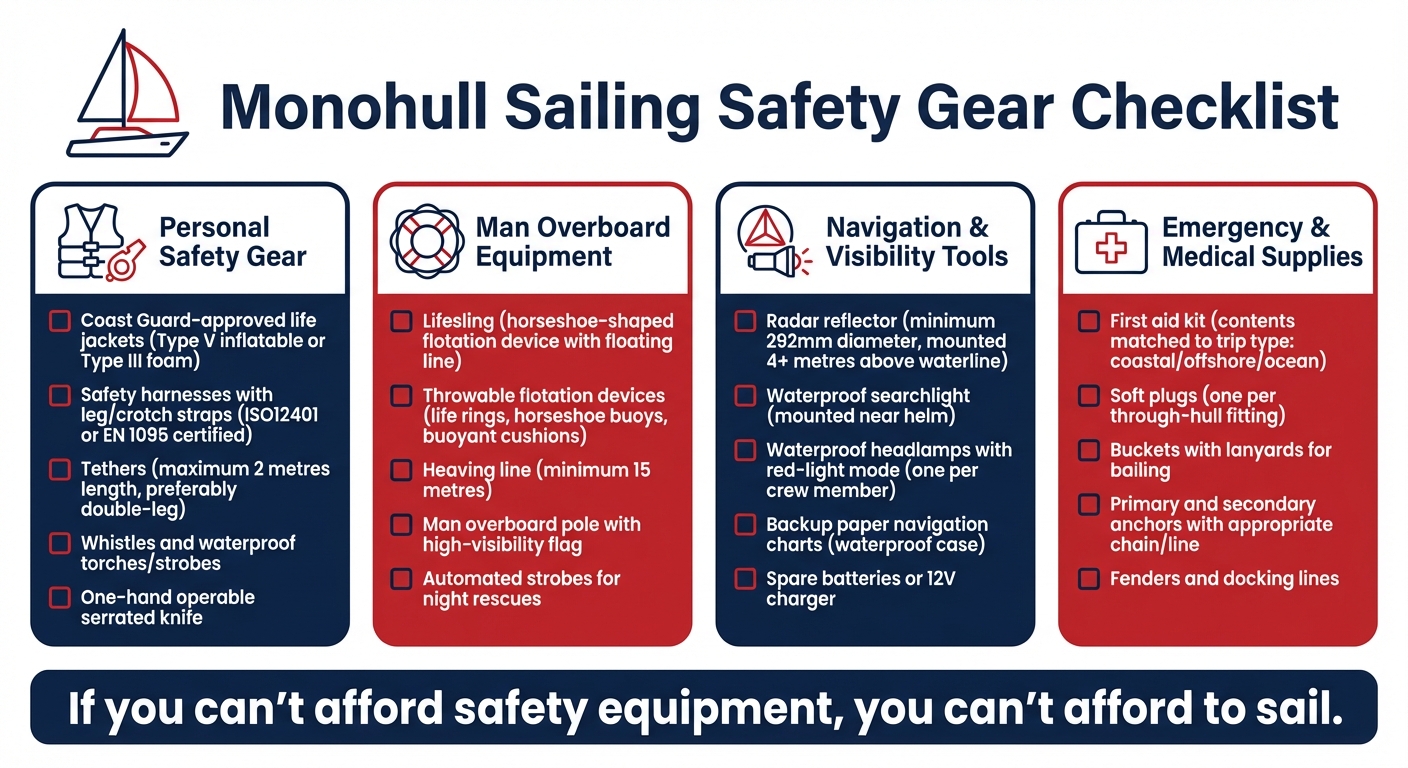
Sailing is thrilling, but safety comes first. Whether you’re cruising near the coast or venturing offshore, having the right safety gear on your monohull is non-negotiable. This checklist covers essentials like life jackets, harnesses, rescue tools, and emergency supplies to help you handle unexpected situations at sea. Here’s what you need:
- Personal Safety Gear: Coast Guard-approved life jackets, safety harnesses, and tethers. Always check their condition before departure.
- Man Overboard Equipment: Lifeslings, throwable flotation devices, and high-visibility markers for quick rescues.
- Navigation Tools: Radar reflectors, waterproof searchlights, and backup paper charts for safe sailing in low visibility.
- Emergency Supplies: First aid kits tailored to your trip, soft plugs for leaks, and anchors to prevent drifting.
Preparation is key to a safe and enjoyable journey. Equip your boat, train your crew, and inspect your gear regularly. As the saying goes: "If you can’t afford safety equipment, you can’t afford to sail."
Essential Safety Gear Checklist for Monohull Sailing
The Sailing Safety Gear Most People Forget Until It’s Too Late
sbb-itb-3563db6
Personal Safety Equipment
Equipping every crew member with the right safety gear is a must when facing the unpredictable nature of the sea. This gear should be within easy reach at all times.
Life Jackets
Having a Coast Guard-approved life jacket for every person on board isn’t just smart – it’s the law. For monohull sailing, consider inflatable Type V models for their comfort and buoyancy, or opt for Type III foam jackets, which often come with extra storage features.
When choosing life jackets, prioritize models with enough buoyancy and crotch straps to keep them securely in place while in the water. Add essential upgrades like a loud whistle for signaling and a small waterproof torch or water strobe for visibility during night sailing. As Hannah Postma puts it:
"The answer is that your boat should always have enough life jackets on it for the number of people it can carry. We actually recommend taking one or two extra ones, just in case".
Before setting sail, check inflatable vests for proper function, inspect gas canisters, and rinse jackets after exposure to saltwater. Alongside life jackets, tethering systems provide an extra layer of safety in challenging conditions.
Safety Harnesses and Tethers
Safety harnesses and tethers are designed to keep you secured to the boat and prevent overboard accidents. These should meet International Standard ISO12401 or European Standard EN 1095, with tethers ideally no longer than 2 metres. Shorter tethers are often safer, as Ron Trossbach of the Cruising Club of America explains:
"The diligent use of a properly adjusted harness and the shortest tether practicable is regarded as by far the most effective way of preventing man overboard incidents".
Double-leg tethers are especially useful, allowing you to stay attached while switching connection points (‘clip-before-unclip’). Harnesses should include leg or crotch straps to prevent slipping out and to ensure your head stays above water if submerged. For monohull sailing, an inflatable jacket with an integrated safety harness is a practical choice, allowing you to secure yourself to jacklines during rough weather.
Always secure the harness while still inside the cabin, and clip onto a jackline or U-bolt before stepping onto the deck. Reverse this process when going below deck. Install a heavy-duty padeye at the companionway and clip in before moving up or down. Never clip onto lifelines; only use dedicated jacklines or bolted deck plates. Additionally, keep a sharp, serrated knife handy – one that can be operated with one hand, to cut your tether in emergencies, such as being dragged underwater.
With your personal safety gear ready, it’s equally important to know when its use becomes critical.
When to Use Personal Safety Gear
Wearing and securing safety gear at the right times can turn potentially dangerous situations into manageable ones.
Life jackets and harnesses aren’t just for emergencies – they’re proactive safety tools. US Sailing recommends wearing harnesses and life jackets offshore from sundown to sunrise while on deck. Beyond nighttime sailing, it’s crucial to secure yourself during rough weather, poor visibility, cold water conditions, or when sailing short-handed or solo.
Experienced sailor Richard du Moulin shares his approach:
"When sailing doublehanded, we’re tethered and clipped on 100 percent of the time. When racing with a full crew, we clip on with the tether at night, and we clip on during the day when conditions warrant".
Certain tasks, such as working on the bow or stern, moving around the steering wheel or traveller, or reefing sails, also require securing onto attachment points. When in doubt, it’s always better to secure your gear right away.
Man Overboard Recovery Equipment
When someone falls overboard, having the right recovery gear and deploying it quickly is crucial.
The Lifesling is a key recovery tool. This horseshoe-shaped flotation device is attached to your boat with a floating line, giving you full control during the rescue. Unlike standard throwable devices, the Lifesling stays connected to the vessel, making it easier to guide the line to the person in the water. To use it effectively, perform a "button-hook" maneuver: steer close to the victim, then sharply turn to ensure the line reaches them. Once the person secures themselves in the sling, you can hoist them aboard using a halyard or winch. To avoid tangles, store the line by stuffing it into its container instead of coiling it. This simple tool can make a huge difference in an emergency.
Throwable flotation devices – like life rings, horseshoe buoys, or buoyant cushions offer immediate buoyancy and help you mark the victim’s position. These should be thrown right away. For shorter distances (one to two boat lengths), a heaving line of at least 15 metres with a bowline knot at the end is ideal. Alternatively, rescue quoits, such as the Marsars 2-in-1, are often easier to use if the first throw misses.
Marking the location of the incident is just as important as providing flotation. A man overboard pole (sometimes called a dan buoy or IOR pole) is a valuable tool for this. As highlighted by Practical Sailor:
"the initial sighting of the victim being left astern was the last sighting"
in many documented cases. The pole, equipped with a high-visibility flag, is much easier to spot from the deck than a person’s head in the water. Modern options, like the MOM 9, combine a pole, flotation, and lights into a single deployable unit.
For night rescues or poor visibility, equip buoys and poles with automated strobes. These lights activate on water contact, creating a bright beacon to help you locate the victim even in challenging conditions.
Navigation and Visibility Equipment
Navigating safely in fog, darkness, or harsh weather demands the right tools to ensure visibility and precision.
Radar Reflector
Making your boat visible to other vessels is just as important as wearing personal safety gear. A radar reflector helps your boat stand out on radar systems, reducing the risk of collisions in crowded waters. This is especially important for wooden or fibreglass monohulls, which tend to absorb radar signals. Look for a reflector with at least a 292-millimetre diameter and install it at least 4 metres above the waterline, ensuring it’s above any surrounding structures for maximum efficiency. As Grant Headifen, Founder of NauticEd, puts it:
"Large shipping traffic relies heavily on radar to avoid collision. Since you and your boat are comparatively small and don’t want to be squashed like a bug, it is a good idea to do what you can to be seen".
Searchlights and Flashlights
A waterproof searchlight mounted near the helm is essential for spotting potential hazards like buoys, debris, or other boats during nighttime sailing. Each crew member should also have a waterproof headlamp, ideally one with a red-light mode to maintain night vision. When selecting handheld lights, ensure they meet IPX4–IPX7 waterproofing standards, and don’t forget to pack spare batteries or a 12V charger.
Paper Navigation Charts
Electronic systems can fail, which is why paper charts are a must-have backup. Before setting sail, double-check that your charts are up-to-date to reflect any recent changes to markers or hazards. Keep them in a waterproof case, and make sure at least one crew member knows how to manually plot a course. These charts are an integral part of a well-rounded safety plan, especially for offshore voyages.
Together, these tools ensure a safer and more secure experience when navigating on a monohull, no matter the conditions.
Emergency and Medical Supplies
Preparing your monohull with the right emergency supplies can make all the difference in critical situations. Along with ensuring that every crew member is ready for emergencies, your vessel must also be equipped to handle medical issues, structural failures, and anchoring challenges.
First Aid Kits and Training
A well-prepared first aid kit is a must. The contents should match your sailing plans – whether you’re staying near the coast, heading offshore, or embarking on long ocean crossings. For day sailing, include basic wound care items. Offshore trips call for trauma pads, pressure dressings, and resuscitation masks. For extended voyages, add broad-spectrum antibiotics, surgical staplers, and monitoring tools.
Shelly Galligan, a registered nurse and USCG 100-ton captain, advises assembling your own kit:
"The quality is off; the quantity is off. You are much better off building your own kits, and it’s much more affordable".
Store your supplies in a waterproof case, organizing them by body system in clearly labelled bags. Include versatile items like plastic wrap for burns or mini bolt cutters for removing fishhooks.
Make sure at least two crew members have CPR and first aid certifications. Courses such as PSC1, PS Mer, or RYA First Aid are excellent options. Check expiration dates on supplies annually, and maintain a medical information sheet for each crew member, listing allergies and medical history.
While medical readiness is crucial, structural emergencies also demand preparation.
Soft Plugs and Buckets
Soft plugs should be placed by every through-hull fitting to quickly stop water from entering the boat. Combine these with buckets equipped with lanyards for manual bailing.
Equipping your boat to handle anchoring emergencies is just as important.
Anchors and Docking Equipment
An anchor is more than just a tool for mooring – it can be a lifesaver. In the event of power or steering failure, deploying an anchor can prevent the boat from drifting into danger or running aground. As Marintech Marketing emphasizes:
"An anchor can be a life saver in an emergency, ensure that you know how to deploy your anchor safely and securely".
Carry both a primary and secondary anchor, with the appropriate length of chain and line for your boat’s size and cruising depths. Practice deploying them with your crew to ensure everyone knows how to act during an emergency.
For docking, keep fenders and docking lines easily accessible. These are essential for securing your vessel when seeking shelter in a harbour or during emergency towing. Just as personal safety gear like life jackets protects individuals, these supplies are vital for safeguarding your boat and crew in urgent situations.
Conclusion
Safe sailing always starts with careful preparation. As Marintech Marketing wisely says:
"A great boating adventure always starts with being safe while you are out at sea. Nothing beats being well prepared while you are in the middle of a crisis in the vast ocean".
This guide highlights the essential gear you need – everything from life jackets and navigation tools to emergency supplies and anchoring equipment. These items are crucial for managing risks while out on the water.
While some safety equipment is legally required, investing in extras like AIS, EPIRBs, and radar reflectors is a smart move, especially for offshore or night sailing. Grant Headifen, Founder of NauticEd, underscores this with a straightforward perspective:
"If you can’t afford to buy safety equipment for your boat you can’t afford to go sailing".
Equally important is making sure your crew is well-trained. Everyone on board should know how to operate the VHF radio, respond to a Man Overboard situation, and provide basic first aid. Regular pre-departure checks and twice-yearly safety gear inspections are also key to smooth sailing.
FAQs
How do I choose the right life jacket and harness for offshore sailing?
When selecting a life jacket, prioritize one that is comfortable, specifically designed for offshore conditions, and equipped with practical features such as an integrated harness, crotch straps, and external pockets for storage. For harnesses, make sure they are capable of keeping your head above water, can be securely attached to a central jackline, and allow you to move freely. To enhance safety, use a double-leg tether, and don’t forget to regularly check all your gear to ensure it meets current safety standards.
What should I practise with my crew before departing (MOB, VHF, first aid)?
Before setting sail, make sure your crew is well-versed in essential safety procedures. This includes practising man overboard (MOB) recovery, mastering VHF radio communication, and understanding basic first aid. Take time to show everyone how to properly use life jackets and emergency devices, as well as where to find all safety equipment onboard. Go over emergency protocols together and demonstrate how to handle potential problems effectively. These steps can make your journey both safer and more reassuring for everyone involved.