
Monohull sailing offers a classic, hands-on experience for both beginners and seasoned sailors. These single-hull vessels excel in upwind performance, stability, and precise handling, making them ideal for Mauritius’ coastal waters. With steady trade winds (15–25 knots from May to October) and warm water temperatures (18–33 °C), Mauritius provides optimal conditions for sailing. However, monohulls come with challenges like limited space and deeper drafts, which can restrict access to shallow lagoons. For safety, always equip your boat with life rafts, GPS, and proper anchoring gear. Whether you’re navigating reef-lined passages or open seas, monohulls deliver control and reliability for memorable maritime journeys.
How Monohulls Are Built and How They Perform
Design and Basic Characteristics
The defining feature of a monohull is its single-hull structure, which plays a critical role in its performance. Its narrow shape and triangular bow are designed to slice through waves rather than ride over them. This design ensures a smoother ride, especially in choppy waters, compared to the bouncing sensation often felt on broader vessels.
A monohull’s keel is weighted to counteract the force of the wind, reducing sideways drift (known as leeway) and enabling the boat to heel safely beyond 20°. As Dream Yacht Sales puts it:
The skipper will feel everything the boat is doing as it performs. Adjusting the sails is more delicate, and accelerations stronger. Monohull yachts give a true sailing experience.
The steering system varies depending on the size of the boat. Smaller monohulls, typically under 9 metres, use tillers, which offer direct feedback to the sailor. Larger monohulls, on the other hand, are equipped with steering wheels that make handling easier. Some modern designs even feature dual steering wheels, which improve visibility when sailing upwind and provide better access to the cockpit. Another critical factor in a monohull’s design is its load waterline length (LWL). A longer waterline allows the yacht to carry more sail area, which generally translates to faster potential speeds.
These design elements are what make monohulls dependable and versatile across diverse water conditions.
How Monohulls Handle Different Water Conditions
When it comes to upwind sailing, monohulls are known for their efficiency. They can typically sail at close-haul angles of 45–50° off the wind, with a total tacking angle of 90–100°. This means that for every leg of a tack, a monohull covers more ground toward the wind, making it a strong performer in these conditions.
In calmer environments, like the lagoons of Mauritius, monohulls maintain impressive control even at low speeds, staying manageable at speeds as slow as 0.75–1.0 knots. For shallow coastal waters, a monohull with a shallow draft or a centreboard is ideal, as it helps avoid grounding while navigating reef-protected areas.
In rough seas, monohulls provide clear feedback when overpowered. Increased heel angles and weather helm act as warnings, as Ben Martin, an instructor at Nautilus Sailing, explains:
The mono gives lots of feedback about being overpowered long before it becomes a problem: heel angle and weather helm are the loudest.
In open waters with larger waves, the monohull’s triangular bow fits naturally into the wave troughs, and the waves roll predictably under the hull. The heavy keel adds to the boat’s stability, helping it maintain momentum during manoeuvres like tacking, which ensures smoother handling even in challenging conditions.
These characteristics highlight why monohulls are a reliable choice for sailors navigating various water conditions.
sbb-itb-3563db6
Reefing While Sailing – Monohull (RAW Lesson)
Pros and Cons of Monohull Sailing
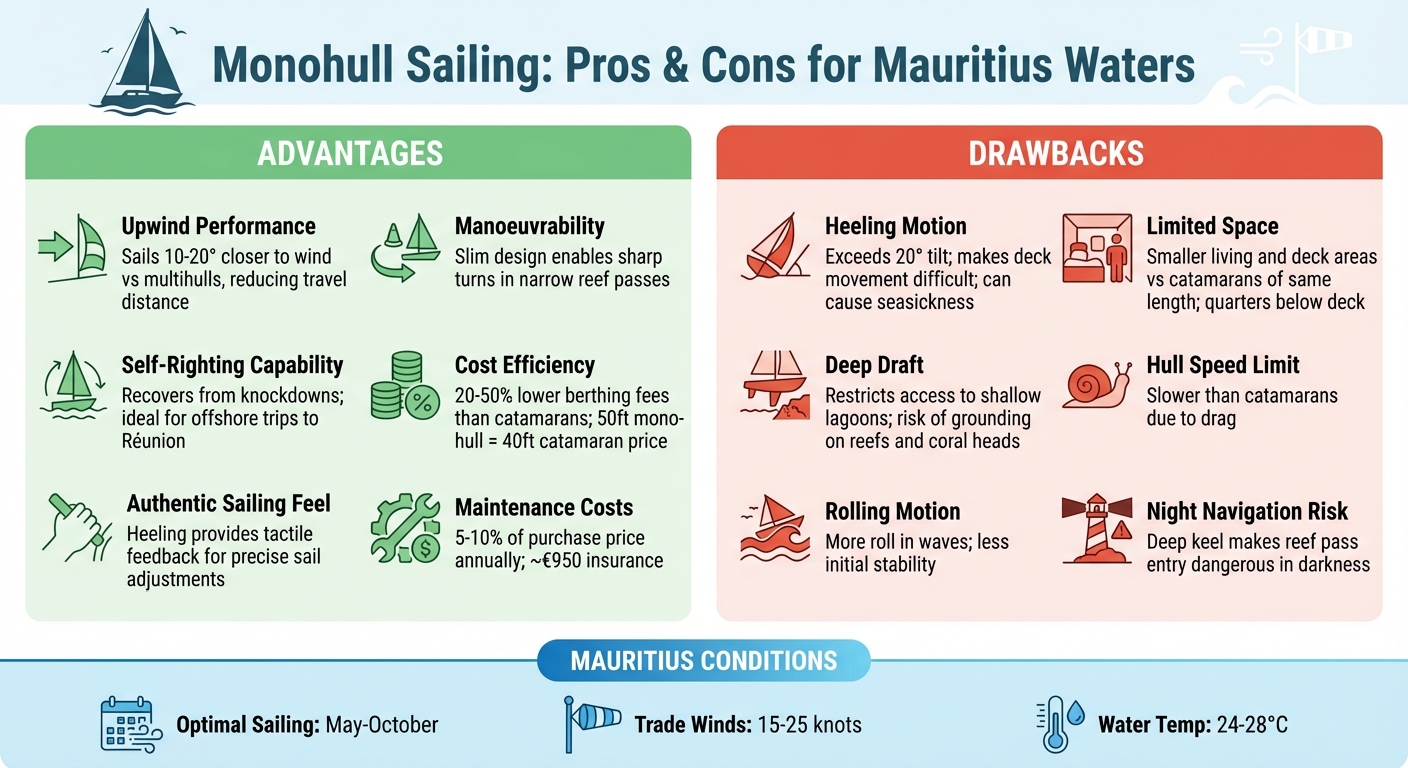
Monohull Sailing Pros and Cons for Mauritius Waters
Benefits of Monohull Sailing
Monohulls bring some distinct advantages when sailing around Mauritius’ coastal waters. Their upwind performance is a standout feature, they can sail 10–20 degrees closer to the wind compared to multihulls. This means you cover less distance when navigating against the island’s prevailing South-East trade winds, which blow at 15–25 knots from May to October.
Another major draw is the authentic sailing experience they provide. The heeling effect, where the boat tilts under wind pressure, gives sailors a tactile connection to the vessel. Adjusting the sails becomes a more precise, hands-on process. As Dream Yacht Sales puts it:
The skipper will feel everything the boat is doing as it performs. Adjusting the sails is more delicate, and accelerations stronger. Monohull yachts give a true sailing experience.
Monohulls also score high on safety and cost efficiency. With their centre of gravity at or below the waterline, these boats have self-righting capabilities, meaning they can recover from knockdowns, a crucial feature for the 120-nautical-mile journey between Mauritius and Réunion, where Southern Ocean swells are common. On the financial side, monohulls are generally cheaper to berth, costing 20–50% less than catamarans of similar size. For example, a 50-foot monohull often matches the price of a 40-foot catamaran. Maintenance costs are also manageable, typically between 5% and 10% of the boat’s purchase price, with insurance averaging around €950 annually.
| Advantage | Benefit for Mauritius Waters |
|---|---|
| Upwind Sailing | Sails 10–20° closer to the wind, reducing travel distance |
| Manoeuvrability | Slim design allows sharp turns in narrow reef passes |
| Self-Righting | Recovers from knockdowns; ideal for offshore trips to Réunion |
| Cost Efficiency | Lower berthing fees and easier marina access |
| Authentic Feel | Heeling provides tactile feedback for precise sailing |
Drawbacks of Monohull Sailing
Despite their advantages, monohulls come with some drawbacks that are worth considering, especially in the context of Mauritius.
The heeling motion, often exceeding 20 degrees, can make moving around on deck challenging and may lead to seasickness for some. While this tilting is part of the traditional sailing experience, it’s not everyone’s cup of tea.
Space limitations are another factor. Compared to catamarans of the same length, monohulls offer much less living and deck space since everything is confined to a single, narrow hull. This creates a snug but more restricted atmosphere, with living quarters located below deck.
The deep keel of monohulls poses a significant challenge for exploring Mauritius’ shallow lagoons and reef-protected areas. Fixed keels often make it difficult to access these zones, requiring constant vigilance to avoid coral heads and bommies. Entering reef passes at night becomes especially risky due to the deeper draft and reduced visibility.
| Drawback | Impact in Mauritius |
|---|---|
| Heeling (Tilting) | Deck movement becomes difficult; can cause seasickness |
| Limited Space | Smaller living and deck areas compared to catamarans |
| Deep Draft | Limits access to shallow lagoons; risks grounding on reefs |
| Hull Speed Limit | Slower than catamarans due to drag |
| Rolling Motion | Rolls more in waves, less initial stability |
For those keen on exploring shallow waters, choosing a monohull with a centreboard or lifting keel can help reduce draft issues while still offering the benefits of superior handling.
Equipment You Need for Monohull Sailing
Safety and Navigation Gear
Before setting sail on a monohull, ensuring you have the right safety equipment is a must. In Mauritius, regulations for sailing beyond 6 nautical miles from shore require essentials like a life raft, life jackets, fire extinguishers, distress flares, and a first aid kit. If you’re heading outside the lagoon, it’s mandatory for everyone onboard to wear Personal Flotation Devices. Options include SOLAS-approved lifejackets, self-rescue bracelets, or inflatable belt packs.
For navigation, having reliable instruments is key to a safe journey. Equip your vessel with GPS units, AIS (Automatic Identification System), radar, a bearing compass, and wind instruments like an anemometer and wind vane. Night sailing calls for proper navigation lighting as per COLREGs – this includes red and green side lights, along with white stern and masthead lights. To preserve night vision, headlamps with a red-light mode are highly recommended.
Mooring equipment is equally vital, especially in the lagoons of Mauritius. Plow anchors are ideal for sandy or muddy seabeds, while grapnel anchors are better suited for rocky areas. Use heavy chains and an electric windlass for larger vessels. Always aim to anchor in sandy or muddy areas to avoid damaging rocky or coral seabeds, which also provide less secure holding. For emergencies, include items like a soft plug (e.g., Forespar TruPlug) for sealing leaks, an emergency tiller, and a drogue for improved steering. As safety expert John Bonds aptly puts it:
Prepare, prevent, prevail.
While safety is paramount, having the right gear onboard also ensures a smoother, more enjoyable journey.
Comfort and Utility Equipment
Comfort can make all the difference during extended coastal trips. Monohulls from Blue Safari Mauritius are designed with this in mind, offering efficient living spaces that cater to multi-day adventures. These vessels typically feature permanent bunks, dedicated cabins, and well-equipped galleys with cooking stoves and integrated water tanks. Depending on the model, configurations range from compact 2-cabin setups to spacious 5-cabin designs, accommodating anywhere from 4 to 12 people.
The galley usually includes a refrigerator, a gas oven, and cooking gas, while sanitary facilities feature marine toilets with holding tanks and onboard showers. For added convenience, many monohulls come with GPS chart plotters, tridata systems, bow thrusters, and electric winches, making handling easier. Comfort is further enhanced by amenities like Wi-Fi, bed linens, towels, and Bluetooth-enabled speakers. On the exterior, a bimini and spray hood provide protection from the tropical sun and sea spray in Mauritius. For emergencies, it’s wise to carry at least 9 litres of drinking water in a sealed container.
| Equipment Category | Items | Purpose |
|---|---|---|
| Safety | Life jackets (SOLAS), Life raft, Flares, Fire extinguishers | Emergency survival and signalling |
| Navigation | GPS, AIS, Radar, Bearing Compass, VHF Radio | Positioning and collision avoidance |
| Mooring | Plow/Grapnel anchor, Chain, Windlass | Securing the vessel in lagoons |
| Comfort | Cabins/Bunks, Galley stove, Water tanks | Long-term habitability |
Safety Guidelines and Pre-Departure Checklist
Weather Checks and Route Planning
Before setting sail, check the Mauritius Meteorological Services (metservice.mu) for a 7-day weather forecast and updates on sea conditions. Pay special attention to S–SW groundswells from the Southern Ocean. These long-period swells can make reef passes like Le Morne and Mahebourg dangerous, even when local winds seem calm.
Timing your passage through reef passes is a key part of planning. Mauritius has tidal ranges between 0.3–0.9 meters, and during spring tides, currents in narrow reef passes can reach 2–3 knots. Aim to navigate these areas during slack water to avoid being pushed off course. Always pass through reef areas in daylight, preferably when the sun is high and behind you – this helps you spot coral heads and sandy patches more easily. As highlighted in the Sailing in Mauritius & Réunion Guide:
Reef passes demand daylight pilotage, the trades can pipe up briskly in the austral winter, and Southern Ocean swell transforms some entrances from inviting to impassable.
Inside the lagoons, stick to marked buoyed channels and always have a lookout positioned on the bow. Use British Admiralty charts for precise navigation: chart 711 for Mauritius, chart 713 for Port Louis and Grande Rivière Noire Bay, and chart 3048 for Grand Port. If you’re entering Port Louis, contact Port Control on VHF Channel 16 for instructions. Once your route is mapped out, it’s time to inspect your boat and gather supplies.
Boat Inspection and Supplies
With your route planned, conduct a thorough inspection of your vessel and ensure all supplies are ready. Check the engine’s oil levels, coolant, and fuel reserves – make sure you have enough fuel to motor for at least 5 hours. Inspect the rigging and reefing lines, especially before the final stretch of your journey. Don’t forget to check all sea cocks, valves, and through-hull openings, and keep softwood plugs nearby in case of emergencies.
Your anchor system should be ready to deploy within 5 minutes. For the lagoon’s sandy or muddy bottoms, plow anchors are the most reliable. Ensure your bilge pump is functioning properly and pack two 9-litre buckets with lanyards for emergency bailing. Safety equipment is equally important, make sure you have two fire extinguishers located in different spots and a fire blanket near your cooking area.
For personal safety, every crew member should wear a SOLAS-approved lifejacket equipped with an automatic strobe light – this is especially critical when venturing outside the lagoon. Verify that your life raft, distress flares, and first aid kit are up to date and easy to access. Lastly, double-check that all navigation and communication devices are working properly.
Sailing Mauritius’ Lagoons on a Monohull
Best Sailing Routes in Mauritius
Mauritius offers two standout routes for monohull sailing, each showcasing the island’s incredible landscapes and unique coastal charm.
The North & West Lagoon Route is a favorite for its mix of natural beauty and urban stops. Starting at Grand Baie, where the channel depth reaches at least 3 metres at high tide, sailors can head north to explore Coin de Mire and Île Plate, both teeming with wildlife. From there, the route curves south-west towards Port Louis and Black River, blending the lively atmosphere of the Caudan Waterfront with dramatic volcanic scenery like Le Morne Brabant. Black River stands out as a secure overnight anchorage, offering excellent protection from the trade winds thanks to its natural shelter.
For those seeking a more adventurous journey, the North & East Explorer Route highlights the breezier east coast. This route features stops at Îlot Bernaches, Amber Island, and the famous Île aux Cerfs, all nestled within lagoons protected by Mauritius’ extensive fringing reef. From May to October, the South-East trade winds blow steadily at 15–25 knots, making this a thrilling option for coastal sailing. However, monohull skippers should navigate carefully, as shallow areas can pose challenges for deeper keels during low tide.
Both routes promise unforgettable views and a variety of anchoring options that cater to different sailing preferences.
Where to Anchor and Stop
Mauritius’ coastline offers plenty of anchoring spots, each suited to different needs and experiences.
Grand Baie is the go-to hub for cruisers, offering sheltered anchorage in sandy patches at depths of 3–10 metres. It’s also a convenient spot for provisioning, with restaurants and shops nearby. Heading south, Black River and La Balise Marina provide secure berths along with fuel, maintenance services, and easy access to the Black River Gorges National Park.
On the east coast, Trou d’Eau Douce and Île aux Cerfs are ideal for mooring, though it’s important to monitor tidal depths carefully. The Blue Bay Marine Park in the south-east is a must-visit for its vibrant coral gardens. To protect the reef, always use designated moorings instead of anchoring directly. For spectacular sunsets, consider anchoring near the lee of Île aux Bénitiers by Le Morne. However, this area can become challenging during heavy S–SW swells.
The northern islets, including Coin de Mire and Îlot Gabriel, are better suited for daytime visits. Anchor carefully on sandy patches to avoid damaging coral, as these spots can become unstable when swells pick up.
Whether you’re after lively marinas or tranquil lagoons, Mauritius has anchorage options to suit every sailor.
Conclusion
Monohull sailing delivers an authentic experience that blends tradition with performance. These vessels are celebrated for their characteristic heeling motion, responsive helm, and exceptional upwind capabilities. In Mauritius, these features shine, especially when navigating the steady South-East trade winds, blowing at 15–25 knots between May and October. Their tighter tacking angles allow for precise maneuvering, making them ideal for exploring the island’s coastal waters.
Mauritius offers a stunning backdrop for sailing, with its emerald lagoons and sheltered anchorages providing the perfect mix of calm and challenge. Beginners can hone their skills in the tranquil waters inside the reef, while seasoned sailors can take on the open seas. Thanks to their deep keel design, monohulls ensure stability and safety, even in rougher conditions, making them a reliable choice for any adventure.
On the practical side, monohulls often come with lower charter costs and reduced marina fees, making them a more budget-friendly option for exploring Mauritius’ diverse coastline.
Whether you’re captivated by the dramatic volcanic peaks of Le Morne, the vibrant wildlife around the northern islets, or the serene beauty of Black River’s protected waters, monohull sailing with Blue Safari Mauritius offers access to all these wonders. The island’s warm waters, ranging from 24–28 °C, coupled with its reliable winds and breathtaking scenery, create the perfect setting for unforgettable sailing experiences.
Set sail with Blue Safari Mauritius and explore Mauritius’ coastline aboard their fully equipped monohulls, designed to cater to sailors of all skill levels.
FAQs
Why are monohulls ideal for exploring Mauritius’ coastal waters?
Monohulls are a solid pick for sailing around Mauritius, thanks to their design that works well with the island’s varied marine conditions. With a deep keel, they offer strong stability and perform especially well when sailing upwind – an advantage in the shifting winds often found along Mauritius’ coastline.
Their single-hull design makes them easy to manoeuvre, which is ideal for navigating close to shore in areas like bays, coves, and reefs. Monohulls are also practical for docking at marinas or anchoring in the many accessible spots around the island. Built to handle rougher seas, they provide a safe and reliable option for sailors, whether you’re a beginner or have years of experience.
From relaxing day trips to exploring vibrant reefs or heading offshore, monohulls strike a great balance between safety, control, and performance for Mauritius’ unique coastal waters.
How does a monohull handle different weather conditions?
Monohulls are known for their adaptability and can handle a variety of weather conditions effectively. In calm to moderate winds, they provide a stable and predictable sailing experience, which makes them a go-to choice for many sailing enthusiasts. However, when the weather turns rough or winds pick up, monohulls tend to heel (lean) noticeably. This requires attentive handling and adjustments to maintain balance and control. Skill and proper sail management are crucial in such scenarios.
The performance of a monohull largely hinges on its design and size. Larger models with thoughtful designs generally offer better stability and are more capable of managing tough conditions. That said, even the most robust monohull demands a skilled and attentive sailor. Always review the weather forecast before heading out, and be ready to reduce the sail area or find shelter if the situation deteriorates. With good preparation and experience, monohulls can deliver a safe and enjoyable journey across a variety of weather conditions.
What safety gear do you need for monohull sailing?
When you’re out sailing on a monohull, having the proper safety gear isn’t just a suggestion – it’s a necessity to keep everyone on board safe. The top priority? A life jacket or personal flotation device (PFD) for every passenger. These provide essential buoyancy in emergencies, giving you peace of mind on the water.
Equally important are safety harnesses and tethers, especially when conditions get choppy. They help secure crew members and reduce the risk of anyone falling overboard.
Other critical items to have on board include distress signals, fire extinguishers, a well-stocked first aid kit, and dependable communication devices like VHF radios or emergency beacons. Depending on your sailing plans and local laws, you might also need additional gear to meet specific requirements. Having these essentials on hand makes your time on the water both safer and more enjoyable.