
Mauritius is a paradise for ocean lovers, offering crystal-clear waters, vibrant marine life, and activities for all skill levels. With warm temperatures (25 °C–28 °C) year-round and visibility up to 50 meters, it’s perfect for snorkeling, diving, and unique experiences like submarine tours. Key highlights include:
- Best spots: Blue Bay Marine Park (72 fish species, 50 coral varieties), Trou aux Biches, and Le Morne.
- Top activities: Scuba diving, snorkeling, whale watching (June–September), and kitesurfing (May–October).
- Family-friendly options: Helmet diving and submarine trips – no certification needed.
- Conservation efforts: Protected marine parks and coral restoration projects ensure sustainable tourism.
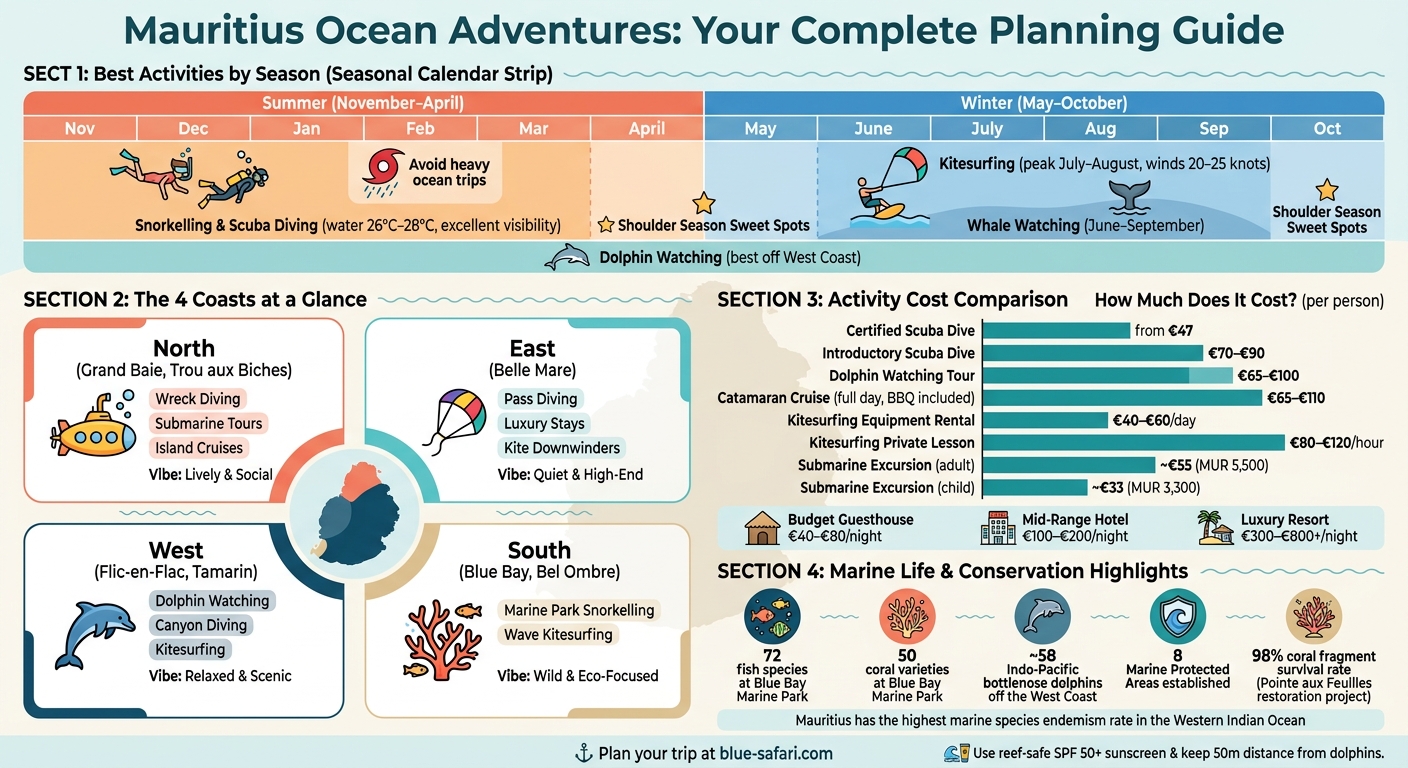
Mauritius Ocean Activities: Best Seasons, Costs & Locations Guide
Mauritius: What Makes It Ideal for Marine Exploration
Geography and Marine Environment
Mauritius, located in the southwestern Indian Ocean, was shaped by volcanic activity around 8 million years ago. The island is surrounded by an almost continuous fringing coral reef system that stretches about 150 km, enclosing a shallow lagoon of approximately 243 km².
This reef system acts as a natural barrier, softening the impact of ocean swells and creating calm, protected waters near the shore. The west coast, or leeward side, enjoys the calmest conditions, with lagoons extending several kilometres out to sea. Meanwhile, the east coast is narrower and more exposed to the southeast trade winds, making it a hotspot for experienced surfers and kite surfers rather than casual swimmers. These geographic features make Mauritius a standout destination for a variety of marine activities.
Climate and Best Seasons for Ocean Activities
Mauritius experiences two main seasons. Summer (été austral, November to April) is warm and humid, with temperatures ranging from 25 °C to 33 °C – perfect for diving and snorkelling thanks to excellent water conditions. Winter (hiver austral, May to October) is cooler and drier, with steady southeast trade winds blowing at 15 to 25 knots, creating ideal conditions for kite surfing, especially during July and August.
For those seeking balanced conditions, May and October are ideal months. These transitional periods offer pleasant temperatures, lower humidity, and favourable sea conditions for most activities. Even in winter, the north and west coasts, including spots like Trou aux Biches and Flic-en-Flac, remain sheltered, making them great year-round options. The table below summarises the best times for specific marine activities.
| Activity | Best Months | Conditions |
|---|---|---|
| Snorkelling & Diving | November – April | Water 26 °C–28 °C, excellent visibility |
| Kite Surfing | May – October | Southeast trade winds; peak in July/August |
| Whale Watching | June – September | Humpback whale migration |
| Dolphin Watching | Year-round | Best off the West Coast |
| Surfing | June – August | Winter swells, especially at Tamarin |
Marine Life and Conservation
Mauritius is home to an incredible array of marine life, supported by ongoing conservation efforts. The waters around the island are teeming with biodiversity and boast the highest rate of marine species endemism in the Western Indian Ocean. One standout species is the Mauritian anemonefish (Amphiprion chrysogaster), which cannot be found anywhere else in the world. Visitors may also encounter sea turtles, reef sharks, and a population of approximately 58 Indo-Pacific bottlenose dolphins residing off the west coast.
Conservation plays a key role in protecting this environment. The island has established eight Marine Protected Areas (MPAs), including the Blue Bay and Balaclava Marine Parks. Additionally, community-driven Voluntary Marine Conservation Areas (VMCAs) have been created, where locals have agreed to halt fishing and resource extraction. Coral restoration projects are also making a difference. Following the MV Wakashio oil spill in 2020, the EcoMode Society initiated coral farming at sites like Pointe aux Feuilles and Flic-en-Flac. Impressively, these efforts achieved a 98 % survival rate for farmed coral fragments at Pointe aux Feuilles over three years.
"Blue carbon is not a simple financial product. It is the tool that will allow us to finance the rescue of our lagoons and the future of our communities." – Dr. Jay Doorga, Researcher, Earth and Ocean Lab, Université des Mascareignes
sbb-itb-3563db6
🌺 TOP 10 Things to do in Mauritius | Adventure in Mauritius
Top Ocean Activities in Mauritius
Mauritius is a treasure trove of ocean adventures, offering activities for families, couples, and thrill-seekers alike.
Snorkelling and Coral Reef Exploration
Snorkelling is one of the simplest ways to explore Mauritius’s stunning marine life. Blue Bay Marine Park, located in the south, is renowned for its vivid coral formations. In the north, Grand Baie offers calm, reef-protected waters where you can hand-feed tropical fish. Meanwhile, the west’s Le Morne boasts a shallow turquoise lagoon, making it an excellent choice for beginners. Most tours include essential gear like masks, fins, and life vests. Guided trips are especially helpful for spotting the healthiest coral and the most active marine life.
For those seeking more depth in their underwater exploration, scuba diving and wreck diving are must-try experiences.
Scuba Diving and Wreck Diving
Mauritius’s East Coast is home to 19 incredible dive sites, including the Ruang Lap, a shipwreck sunk in 2015 that lies at a depth of 25 to 27 metres. French-certified divers (FFESSM levels) are usually recognised, though it’s a good idea to confirm equivalency with your chosen operator before booking.
Underwater Experiences with Blue Safari Mauritius
You don’t need a diving certification to enjoy every underwater adventure. Blue Safari Mauritius offers submarine excursions that dive to 35 metres below the surface. These trips, departing from Trou aux Biches in the north for adults and children aged 2 to 12.
"It’s one of the only places in the world where tourists can ride in a real submarine, not just a semi-submersible or glass-bottom boat." – Vignesh Kumar, Author, Planet-Trekker-Blog
With limited seating for just 10 passengers, early booking is essential. Blue Safari also offers other oceanic experiences, such as catamaran cruises along the west coast and speedboat tours from the north. These tours often include dolphin watching and snorkelling stops, making them perfect for a full day on the water.
If you prefer adventures above the waves, Mauritius doesn’t disappoint.
Water Sports and Big Game Fishing
Le Morne, located on the southwest tip of the island, is a hotspot for kitesurfing and windsurfing.
"Le Morne brings together everything that makes a complete spot: a shallow turquoise lagoon inside the reef… flat water for speed and freestyle, and world-class waves on the reef." – ION CLUB Le Morne
Beginners can practice in the sheltered lagoon, while seasoned surfers can tackle the reef’s challenging waves. The main season runs from April to November, with peak winds of 20 to 25 knots between August and October.
For fishing enthusiasts, Mauritius offers prime big game fishing opportunities, especially from November to April when warm currents attract marlin, tuna, and wahoo. Blue Safari Mauritius also organises fishing trips with skilled crews and specialised boats, catering to both big game and light tackle fishing fans.
How to Plan Your Ocean Adventure in Mauritius
Maximizing your time in Mauritius means planning ahead to explore its four distinct coasts. Thanks to the island’s compact size, it’s easy to visit multiple coasts during your stay. Each one offers something special, so creating a customized itinerary is key to experiencing Mauritius’s full marine charm.
Choosing the Right Coast and Base
Pick your base depending on what activities you want to prioritize. The North (Grand Baie, Trou aux Biches) is a hub for calm lagoons, wreck diving, and submarine tours like those offered by Blue Safari Mauritius. The West (Flic-en-Flac, Tamarin) is perfect for dolphin watching, canyon diving, and catching breathtaking sunsets. If you’re after serene lagoons and a more exclusive vibe, head to the East (Belle Mare), which is also great for beginner-friendly kitesurfing. The South (Blue Bay, Bel Ombre) is the go-to spot for snorkeling in a protected marine park.
| Coast | Best For | Vibe |
|---|---|---|
| North | Wreck diving, submarine tours, island cruises | Lively, social |
| West | Dolphin watching, canyon diving, kitesurfing | Relaxed, scenic |
| East | Pass diving, luxury stays, kite downwinders | Quiet, high-end |
| South | Marine park snorkeling, wave kitesurfing | Wild, eco-focused |
Water visibility ranges from 20 m to 50 m, and temperatures stay between 24 °C and 28 °C year-round, so you can enjoy great conditions almost anytime. Once you’ve chosen your base, plan your activities to fit the flow of your trip.
Sample Itineraries for Ocean Trips
For a 7-night stay, consider starting on the North or West coast for diving and submarine adventures, then wrapping up in the South at Blue Bay for marine park snorkeling. If you have 10 nights, add a stop on the East coast for a catamaran cruise to Île aux Cerfs and a kitesurfing session. The best times to visit are during the shoulder seasons, April to June and September to November, when the water is warm, the humidity is lower, and the crowds are smaller.
"October and November… It’s like Mauritius at its most confident – not trying too hard, just naturally stunning." – Taxi Service Mauritius
Avoid planning a heavily ocean-focused trip between January and March, as cyclone season can lead to rough seas and disruptions.
How to Stay Safe and Respect the Ocean in Mauritius
Mauritius offers a fantastic playground for ocean lovers, but the sea commands respect. By following a few simple guidelines, you can ensure your safety and help preserve the marine environment for future generations.
Safety and Fitness Tips
Ocean activities in Mauritius cater to a wide range of fitness levels. For snorkelling, basic swimming skills are enough, while scuba diving requires a recognised certification like PADI, SSI, or CMAS at an Open Water Diver level at minimum. Helmet diving, on the other hand, is beginner-friendly and even suitable for kids as young as seven years old.
The sun in Mauritius is no joke. With a UV index that can hit 11, sunburns can happen in as little as 15 minutes. Use SPF 50+ sunscreen, applying it 30 minutes before heading out and reapplying every two hours. Always pay attention to the beach flag system before going into the water:
| Flag Colour | Meaning | What to Do |
|---|---|---|
| Green | Safe to swim | Follow basic safety precautions |
| Yellow | Caution | Stay near a lifeguard |
| Red | No swimming | Avoid entering the water |
| Purple | Dangerous marine life | Be extremely cautious |
Inside the coral reef, waters are typically calm, but venturing beyond the reef should only be done with a guide. Strong currents and sudden swells can be hazardous. If you find yourself caught in a rip current, don’t panic or fight it. Swim parallel to the shore to escape, then head back diagonally. Save these emergency contacts in your phone: 999 (general), 114 (ambulance), and +230 428 3666 (Coast Guard).
Now that you know how to stay safe, let’s talk about protecting the beautiful marine ecosystem.
Protecting the Marine Environment
Mauritius’ reefs and marine life are delicate and need your care. Here are a few essential rules to follow:
- Don’t touch or step on coral. Even slight damage can take decades to recover.
- Use reef-safe sunscreen. Mineral-based formulas avoid harmful chemicals that contribute to coral bleaching.
- Respect local regulations. Blue Bay Marine Park, a protected RAMSAR site spanning 353 hectares, enforces strict rules to safeguard its ecosystem.
When it comes to dolphin and whale watching, it’s crucial to approach responsibly. Boats must reduce speed and travel parallel to the animals’ direction – never head-on or from behind. Keep a minimum distance of 50 metres from dolphins and 3 metres from sea turtles. Feeding marine life or making loud noises to attract them is strictly prohibited, as it disrupts their natural behaviour.
Angèle, the founder of Voyage Île Maurice, highlights the importance of ethical practices:
"Swimming with dolphins in Mauritius can be a positive and enriching experience provided you opt for a service provider who prioritises ethics and adheres to the safety guidelines for the animals."
What to Pack for Ocean Adventures
Packing smart can save you time, money, and hassle. Here’s what French travellers should bring for ocean activities in Mauritius:
- Reef shoes: A must-have. They protect you from hidden dangers like stonefish, whose venom is extremely painful, as well as sea urchins and fire coral.
- Reef-safe SPF 50+ sunscreen: Safeguards both your skin and the coral reefs.
- Rash guard or shorty wetsuit: Handy between May and October when water temperatures drop slightly, and great for UV protection during long snorkelling sessions.
- Reusable water bottle: Keeps you hydrated and reduces plastic waste on boats.
- Waterproof dry bag: Protects your valuables like phones, documents, and towels from sea spray.
- Diving certification card: Essential for scuba diving trips – don’t forget it.
- Polarised sunglasses: Reduces surface glare, making it easier to spot marine life from the boat.
If you wear glasses or contact lenses, don’t worry – helmet diving is designed to accommodate both.
Conclusion: Start Planning Your Mauritius Ocean Adventure
Mauritius is a dream destination for ocean lovers, offering a variety of unforgettable experiences along its stunning coastlines. Whether it’s swimming with dolphins in Tamarin Bay on the West Coast or exploring the islands of Coin de Mire and Gabriel Island in the North, there’s something for everyone. From first-time snorkelers to experienced divers, Mauritius caters to all skill levels, making it an inviting destination for any ocean enthusiast.
The island makes underwater exploration surprisingly easy. Activities like submarine dives and the Solar Sea Walk allow visitors to experience the wonders of the ocean without needing advanced training or equipment.
"Imagine a world where vibrant corals sway, exotic marine life drifts by, and mysteries of the deep intrigue your curiosity." – Blue Safari Mauritius
Timing your visit can enhance the experience. Whale watching is at its peak from August to October. If you’re planning a catamaran cruise, prices start at Rs 1 250, while private speedboat charters begin at Rs 12 000. These options ensure there’s an adventure suited to every traveller’s preferences.
Blue Safari Mauritius offers an incredible variety of ocean activities, including submarine excursions, catamaran cruises, dolphin watching, and big game fishing. To explore these options and book your perfect adventure, visit blue-safari.com.
FAQs
Which coast should I stay on for my favourite activities?
For those craving ocean adventures, the West Coast is a fantastic choice. Here, you’ll find calm waters, invitingly warm temperatures, and breathtaking sunsets. It’s a prime spot for activities like dolphin watching at Tamarin Bay and Black River, or snorkeling around the famous Crystal Rock.
If kitesurfing is your thing, the Le Morne Peninsula in the southwest is the place to be, thanks to its steady trade winds that create ideal conditions.
For a more tranquil experience or to catch a stunning sunrise, the East Coast offers a peaceful escape with its serene beaches and quieter atmosphere.
Do I need a diving certificate for underwater experiences?
No, you don’t need a diving certificate or any prior diving experience to enjoy underwater activities in Mauritius. Experiences like submarine rides and subscooter tours are specifically designed to be accessible for everyone, including non-divers and even non-swimmers. Professional guides are there to provide all the training and supervision you’ll need, making sure your underwater adventure is both safe and fun.
How can I choose an ethical dolphin or whale tour?
To pick a tour that respects wildlife and the environment, focus on operators certified by the Mauritius Tourism Authority. These providers follow guidelines that emphasize conservation and responsible practices.
Here’s what to look for:
- No-touch and no-chase policies: Ensuring animals are not disturbed or stressed.
- Safe distances: Maintaining at least 50 metres from wildlife.
- Gentle approach: Approaching animals slowly from the side to avoid startling them.
- Engine management: Keeping engines at idle speed to reduce noise and pollution.
Additionally, responsible operators take steps to educate visitors about marine ecosystems, limit the size of tour groups, and avoid feeding or baiting animals to preserve their natural behaviours. These measures help ensure that your experience doesn’t come at the expense of the environment.