
If I had to pick fast, I’d match the activity to one thing first: my child’s age and water confidence. In this guide, the safest low-effort picks are glass-bottom boat rides and supervised beach time. For children who swim with ease, lagoon snorkelling is the next step. For longer days, catamaran trips and dolphin outings suit families who can handle 6 to 9,5 hours at sea. And for older children, kayaking adds more movement.
Here’s the short version:
- Best for babies and toddlers: glass-bottom boat rides, beach activities
- Best for children aged 5+: calm lagoon snorkelling
- Best for older children, often 10+: kayaking
- Best for mixed ages: catamaran day trips
- Best for wildlife spotting: dolphin-watching on the west coast
- Best short outing: glass-bottom boat rides, often around 1 hour
- Best full-day comfort on a boat: catamarans with shade and toilets
- Best coast for calm lagoon trips: Blue Bay / south-east
- Best coast for dolphins: Tamarin / west coast
- Best coast for easy family access: Grand Baie / north coast
I’d also keep three facts in mind before booking:
- Morning trips, often 08:00–10:00, usually mean calmer water
- From May to October, visibility is often clearer, but wind can be stronger on the east coast
- Sea water stays near 27 °C through the year, but children can still feel cold after swimming
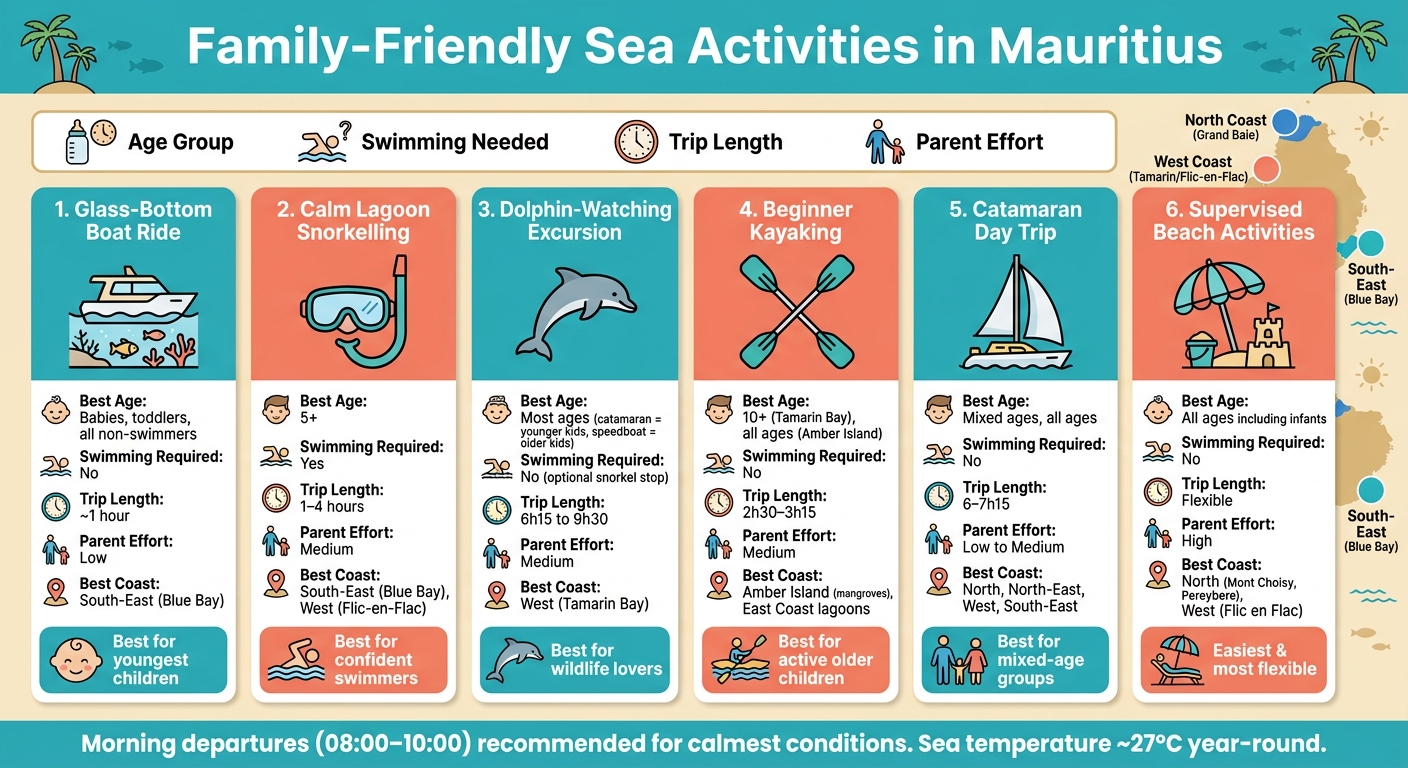
Family-Friendly Sea Activities in Mauritius: Age & Effort Guide
BIG SPERM WHALES Swimming with Little Kids! Underwater Bucket List Family Adventure in Mauritius!
sbb-itb-3563db6
Quick Comparison
| Activity | Best age group | Swimming needed | Usual trip length | Parent effort | Main point to watch |
|---|---|---|---|---|---|
| Glass-bottom boat | Babies, toddlers, cautious children | No | ~ 1 hour | Low | Check child-size life jackets |
| Lagoon snorkelling | 5+ | Yes | 1 to 4 hours | Medium | Child must feel calm in the water |
| Dolphin watching | Most ages | No, unless snorkelling stop | 6,25 to 9,5 hours | Medium | Early starts and open sea |
| Kayaking | Older children, often 10+ in some spots | No | 2,5 to 3,25 hours | Medium | Sun and paddling effort |
| Catamaran trip | Mixed ages | No | 6 to 7,25 hours | Low to medium | Long day for toddlers |
| Beach activities | All ages | No | Flexible | High | Sun, tide, and weekend crowds |
If I wanted the plain answer: pick glass-bottom boats or beaches for small children, snorkelling for confident swimmers, kayaking for older children, and catamarans for mixed-age groups.
1. Glass-Bottom Boat Rides
Glass-bottom boat rides are one of the easiest sea activities in Mauritius for families with very young children. There are no age limits in many cases, so babies, toddlers, non-swimmers, and cautious children can come along without needing any swimming skills. Through the glass floor panels, families can look straight down at coral and fish below.
That’s why this is often a smart first pick for younger children and kids who feel unsure in the water.
Child Safety
Operators provide life jackets for all passengers, and these boats are made for calm lagoon waters. If you’re travelling with a child under 5, it’s wise to bring your own well-fitted life jacket, since the ones on board may be too big for smaller children. Many boats also have shaded areas and space for strollers and wheelchairs, which helps if your group includes babies, grandparents, or both.
Age Suitability
Babies aged 0–2 usually travel free. At Belle Mare, some operators set a minimum age of 4, so it’s worth checking before you book.
Duration and Comfort
Most tours last about 1 hour, which works well for young children who may lose interest on longer outings. If you want more space or a quieter trip, private tours.
Sea Conditions and Coastal Areas
Blue Bay Marine Park, on the south-east coast, is the spot most often recommended for families. Its protected lagoon has calm, clear water with an average depth of about 5,5 metres, and there’s plenty of marine life to see. Grand Baie in the north and Belle Mare on the east coast are also popular, although sea conditions can shift with the season. From May to October, visibility is often at its clearest.
For families who want a bit more hands-on time in the water, calm lagoon snorkelling is the next step up in effort and activity.
2. Calm Lagoon Snorkelling
Calm lagoon snorkelling is a good fit for families with children who feel at ease in the water and want to see marine life up close. It gives kids a more direct experience than a glass-bottom boat ride, which makes it better for those who are ready to get in and swim.
Child Safety
Most operators provide a mask, fins, and a life jacket or another flotation aid. For families, guided sessions are the safest option because supervision is much higher.
A simple tip that can make a big difference: book a morning departure. Slots between 08:00 and 10:00 usually have the clearest underwater visibility and the calmest sea conditions.
Age Suitability
Direct snorkelling in the lagoon suits children aged 5+ who are confident in the water. If you’re visiting between May and October, bring a light windproof or rain jacket for each child. Water temperatures are usually 20 °C to 25 °C, and children often cool down fast once they get out of the water.
Duration and Comfort
You can match the tour length to your family’s energy level. A 1-hour session, with about 45 minutes in the water, tends to work well for younger children who tire more fast.
Sea Conditions and Coastal Areas
Blue Bay Marine Park is often the first pick for families. It has protected coral gardens, lots of marine life, and easy access from the pier or public beach. Flic-en-Flac on the west coast is another good spot, with gentle, shallow water where children can often see tropical fish near the shore. Pointe d’Esny, close to Blue Bay, is known for its clear water and is often part of lagoon tours that continue towards Île aux Aigrettes.
Families who would rather stay dry can look at dolphin-watching excursions next.
3. Dolphin-Watching Excursions
Dolphin-watching excursions mix wildlife spotting with a slower, more relaxed day on the water. For families, the boat type can change the whole feel of the trip. Catamarans usually work better for younger children, while speedboats tend to suit older children. That gap matters most if you’re travelling with little ones or with swimmers who get uneasy in rougher water.
Child Safety
All Blue Safari vessels carry full safety equipment, including life jackets, and every trip starts with a mandatory safety briefing on board.
For family comfort, catamarans have a clear edge. They offer shaded seating and marine toilets, which can make a long outing much easier with children. And if anyone in your group gets motion sickness, a catamaran is the steadier and safer pick.
Age Suitability
Catamarans are the better fit for babies, toddlers, and younger children. Their dual-hull design helps keep the boat stable, and the larger deck gives children more space to move around safely.
Older children and teenagers often prefer the speedboat option. The faster ride and open sea views can feel more fun and more dynamic. Once you’ve picked the right boat, the next thing to check is the trip length.
Duration and Comfort
The West Coast sharing catamaran runs from 09:15 to 15:30. It includes dolphin watching in the open sea, snorkelling in the sheltered lagoon of L’Harmonie, a stop at Crystal Rock, and a Mauritian BBQ lunch prepared on board.
The North to South West speedboat tour runs from 06:30 to 16:00. That’s a long day out, so it’s a better match for active families with older children who can stay comfortable on the water for hours.
| Trip Type | Timing | Onboard Comfort |
|---|---|---|
| West Coast Catamaran (Sharing) | 09:15 – 15:30 (6 h 15) | High: shaded seating, marine toilets, BBQ station |
| North to West Speedboat (Exclusive) | 07:00 – 15:30 (8 h 30) | Moderate: faster travel, wide sea views, limited deck space |
| Full Day North to South West | 06:30 – 16:00 (9 h 30) | Moderate: longest option; suits active families |
Sea Conditions and Coastal Areas
The route matters just as much as the boat. On the West Coast, especially around Tamarin Bay and Black River, dolphin sightings are most common.
After the dolphin encounter, catamaran trips head into the calm, sheltered waters of L’Harmonie lagoon for snorkelling. That part of the day is much gentler for children. The dolphin search itself happens in the open sea, where the water can be choppier than in a lagoon.
One last point: sightings are never guaranteed. Tours depend on weather conditions and may be rescheduled if the sea is rough.
4. Beginner-Friendly Kayaking
Kayaking is a good middle ground for families who want more movement than a boat trip but don’t want to jump straight into snorkelling. It gives you a bit more to do, without feeling too full-on. For most families, tandem kayaks make the most sense: the adult handles most of the paddling and steering, while the child sits steadily in front.
Child Safety
Tours include children’s life jackets and a pre-launch safety briefing. That setup makes kayaking much easier for families, since the child can stay seated up front while the adult takes care of the main work.
One thing to plan for: kayaks have no shade. Bring high-factor sunscreen, a hat, and sunglasses. On the water, the sun can feel stronger than people expect.
Age Suitability
Amber Island is open to all ages, and children under 12 get reduced rates. That makes it the easier pick for families with younger kids.
Tamarin Bay has a minimum age of 10+, so it fits better for older children and teenagers who are happy with a bit more activity.
Duration and Comfort
Amber Island lasts 3 h 15 min, while Tamarin Bay lasts 2 h 30 min.
That difference matters more than it may seem. A longer outing can be lovely in calm water, but with younger children, comfort often comes down to how long they can stay happy, seated, and in the sun.
Sea Conditions and Coastal Areas
Amber Island is the better fit for younger children. The mangroves and shallow channels keep the water flat, even on breezy days. In plain terms, it feels calmer and easier from start to finish.
Tamarin Bay works best early in the morning. The 06:30 start helps you avoid stronger winds and heavier boat traffic. East Coast lagoons are usually calm and clear, but they can get harder from May to August when the trade winds pick up.
| Kayaking Spot | Effort | Stability | Best for | Less suitable for |
|---|---|---|---|---|
| Amber Island (Mangroves) | Low: gentle paddling through sheltered channels | High: shallow, flat water | All ages, including young children | Families wanting open-water views |
| Tamarin Bay (Open Bay) | Moderate: paddling into the bay | Moderate: light swells possible | Active families with children aged 10+ | Young children or those prone to motion sickness |
| East Coast Lagoons | Variable: low in summer, moderate to high in winter | High: typically calm, clear lagoon | Families visiting between November and April | Families travelling May–August |
For families who want less paddling and more relaxed time on the water, catamaran trips are the natural next step.
5. Catamaran Day Trips
Catamaran day trips work well for families who want the calmest full-day option at sea. Blue Safari catamarans have shaded seating, sun-lounging areas, and bow nets, which gives everyone space to sit back and spread out.
Child Safety
Before departure, the crew gives a safety briefing and hands out marine safety equipment. Children need adult supervision for the whole trip.
Snorkelling stops usually happen in calm lagoons like Trou Moutou or L’Harmonie. These spots are sheltered, which makes the water easier for younger swimmers. Masks and snorkels are provided on board.
Age Suitability
Catamaran cruises are open to all ages, including young children. That makes them one of the easier full-day boat options for families. Onboard toilets, shaded seating, and BBQ meals cover the basics parents usually care about most. The upper deck also gives children a clear view without having to lean over the sides.
Duration and Comfort
Full-day cruises last from 6 h to 7 h 15, depending on the route. That can feel like a long stretch for toddlers, even on a calm boat. In many cases, the 2-hour sunset cruise is a better fit. It stays inside the lagoon and offers a shorter, gentler outing.
Sea Conditions and Coastal Areas
Morning departures usually bring the calmest sea conditions, which can help lower the chance of seasickness for younger passengers. Route choice also makes a big difference. Sheltered north-east itineraries tend to suit younger children best, while more open routes are often better for older kids who feel steady in the water.
| Route (Blue Safari) | Duration | Max Capacity | Meal Options | Suitability for Younger Children |
|---|---|---|---|---|
| North Coast | 7 h 15 min | 29 passengers | BBQ lunch & drinks | High; well-paced with island stops |
| North-East Coast | 6 h | 18 passengers | BBQ lunch & cocktails | Very high; sheltered mangroves and calm beaches |
| South-East Coast | 7 h | 37 passengers | BBQ lunch & drinks | Moderate; involves more open-water navigation |
| West Coast | 6 h | 36 passengers | BBQ lunch & drinks | High; calm lagoon and island stops |
For families who want to stay even closer to shore, supervised beach activities are the simplest next option.
6. Supervised Beach Activities
Supervised beach activities are the easiest and most flexible option in this comparison. For families with very young children, they’re the default pick. You don’t need to work around boat timetables, carry gear, or deal with open water. If ease matters more than taking a boat trip, the beach is the simplest route.
Child Safety
Coral reefs help keep waves low along the shore, which makes shallow wading easier for children. At popular public beaches like Flic en Flac and Mont Choisy, lifeguards and clearly marked swimming zones help keep children in safe areas. For children under five in shallow water, a properly fitted life jacket can give parents extra peace of mind.
Age Suitability
This option works for all ages, including infants, and doesn’t require any skills. Beaches like Pereybere and Mont Choisy on the north coast have compact stretches of sand, shallow water, and casuarina shade, which makes supervision much easier for parents.
Duration and Comfort
Families can stay for as long as they want, with direct access to restrooms, changing rooms, and medical facilities that are limited or missing on small vessels. Mont Choisy and Pereybere are especially handy because of their natural shade and nearby food stalls.
Sea Conditions and Coastal Areas
For a beach day, wind and tide matter more than distance or gear. From May to October, stronger winds on the east coast can make beach outings less comfortable for young children. The west coast, including Flic en Flac, is usually calmer during this period, which makes it the better option. Low tide can reduce swimming depth, while high tide can make shallow wading a bit harder for toddlers. On weekends, it helps to arrive early so you can get a shaded spot before the beach gets busy.
Pros and Cons by Family Type and Coastal Area
Once you’ve compared the activities one by one, the easiest way to narrow things down is to look at your children’s ages and where you’re staying on the island.
That tends to make the decision much simpler.
Toddlers usually do best with glass-bottom boats or supervised beach time. School-age children are often a good match for calm lagoon snorkelling. Dolphin watching works for most ages, but those early starts can be rough with little ones. Older children are usually better suited to beginner-friendly kayaking. And if you’re travelling with children of different ages, a catamaran day trip can work well, although the 6–7 h schedule is a big chunk of the day.
Use the table below to match each activity with the family setup that fits it best.
| Activity | Best-Fit Age Group | Adult supervision needed | Ease for parents | Key Limitation |
|---|---|---|---|---|
| Glass-Bottom Boat | Toddlers & infants | Low (guided, stay on boat) | High (stay dry) | Limited to specific marine parks |
| Lagoon Snorkelling | School-age children | High | Moderate | Requires basic swimming confidence |
| Dolphin Watching | All ages | Moderate | High | Early morning departures are usually needed |
| Beginner Kayaking | Older children | Moderate | Moderate | Physical effort required |
| Catamaran Trip | Mixed-age groups | Low–Moderate | High | Full-day commitment (6–7 h) |
| Beach Activities | Toddlers & school-age children | High | High | Sun exposure and no reef viewing |
Where you go matters almost as much as what you do.
The south-east lagoon, centred on Blue Bay Marine Park, is the easiest area for short outings with young children. The water is calm, sheltered, and easy to handle when you don’t want a long or tiring trip. If your goal is dolphin encounters, the west coast around Tamarin and Flic en Flac is the better pick. Morning waters are usually calm there, but departures around 06:30 can be tough for younger children. The north coast, around Grand Baie and Mont Choisy, is often the most practical base for families who want a bit of everything, mostly because access and transport links are easier.
| Coastal Area | Best For | Standout Feature | Water Conditions |
|---|---|---|---|
| West Coast (Tamarin / Flic en Flac) | Dolphin watching, older children | Calm morning waters and strong dolphin activity | Calm coves with deeper reef access |
| North Coast (Grand Baie / Mont Choisy) | Logistics, mixed-age groups | Easy access to operators and transport links | Generally calm; busier boat traffic |
| South-East Lagoon (Blue Bay / Mahebourg) | Toddlers, short outings | Blue Bay Marine Park and easy glass-bottom boat trips | Very shallow and protected lagoons |
Seawater stays at about 27 °C through the year, so the main factors are usually shelter, timing, and trip length, not the water temperature.
Conclusion
The best option depends on three simple things: your child’s age, how at ease they feel in the water, and how long your family wants to stay out.
For the easiest start, go with a glass-bottom boat ride. It’s a good fit for non-swimmers and young children aged 3+. If your child is a confident swimmer, calm lagoon snorkelling is a natural next step. Dolphin-watching excursions are a good pick for families staying on the west coast, though the early departures are worth planning around. Beginner-friendly kayaking tends to suit older children, usually 10+. And if your group includes children of different ages, a catamaran day trip often works best for a full day on the water.
Before booking, check that child-sized life jackets and masks are available, especially for younger children.
Match the activity to your child’s age, confidence, and stamina.
FAQs
Which sea activity is safest for first-time young children?
Glass-bottom boat tours are often the safest pick for young children trying this for the first time. Kids get to see marine life without getting in the water, which takes a lot of the stress out of the day. The boats are enclosed, comfortable, and stable, so the whole trip tends to feel easy for both children and parents.
If they’re keen to get in the water, shallow, calm lagoons are usually the best setting for a first snorkelling session. Catamaran cruises also work well for families because they have stable decks, protective netting, and child-sized life jackets.
What should I pack for a family sea trip in Mauritius?
Pack the basics for comfort, sun cover, and peace of mind:
- Reef-safe sunscreen, hats, sunglasses, and light swimwear
- Towels and a spare set of clothes
- A camera or smartphone in a waterproof case
- Your own snorkelling gear or flotation devices if your children like using familiar ones
It also helps to bring some local cash for park fees, tips, or extra snacks.
How do I choose between a catamaran, snorkelling trip or beach day?
Choose the option that fits your family’s comfort level, your children’s ages, and how much energy everyone has on the day.
- Catamaran cruises: best if you want a steady, full-day trip with sailing, snorkelling, and meals onboard.
- Snorkelling trips: a good fit for children who feel at ease in the water and enjoy calm, shallow lagoons.
- Beach days: the easiest and most flexible choice, especially with very young children.