
Coral reefs transform dramatically at night. As the sun sets, diurnal species retreat, and nocturnal creatures emerge. Coral polyps extend their tentacles to catch plankton, while predators like sharks and eels hunt under the cover of darkness. This nightly shift supports feeding, reproduction, and migration patterns crucial to reef ecosystems.
Key insights:
- Nighttime activity: Coral polyps feed on plankton; predators like lionfish and moray eels hunt stealthily.
- Lunar cycles: Over 130 coral species synchronize their spawning to specific moon phases.
- Diel Vertical Migration: Billions of zooplankton rise to the surface nightly, fueling the food chain.
- Artificial light pollution: Coastal lighting disrupts natural rhythms, affecting coral spawning and marine species’ behavior.
Protecting reefs involves reducing artificial light, using low-impact LEDs, and timing lights to preserve natural cycles. These steps can help mitigate human impact while maintaining the delicate balance of nocturnal reef ecosystems.
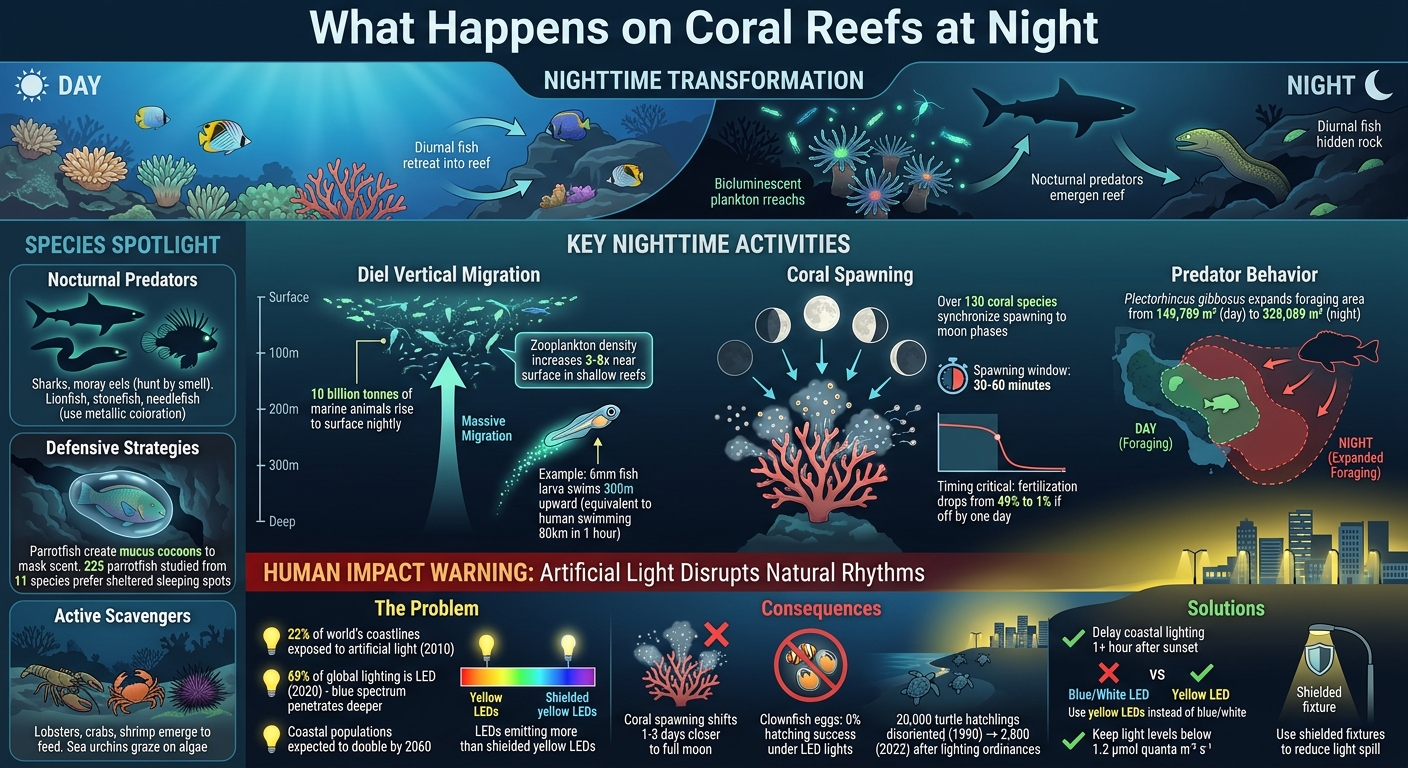
Nocturnal Coral Reef Ecosystem: Key Activities and Species Behavior at Night
Marine Species Active at Night
Nocturnal Predators
When night falls, some of the ocean’s most skilled hunters come into play. Sharks and moray eels, for instance, rely on their finely tuned sense of smell to locate prey in the darkness. Their olfactory systems are so sharp that prey species have developed clever ways to avoid detection. Photographer and diver Umeed Mistry shared an intriguing observation:
A sleeping parrotfish is holed up inside a mucous bubble of its own making to mask its odours from reaching nocturnal predators like sharks and eels.
Other predators, like stonefish, lionfish, and needlefish, take a stealthier route. They use special coloration, often metallic silvers and reds – that reflects minimal light, making them nearly invisible in the dark. Stonefish, in particular, are masters of disguise, blending seamlessly with their surroundings and lying in wait for unsuspecting prey to come too close.
While these predators dominate the night, herbivorous fish adopt different strategies to stay safe.
Plant-Eating Fish and Nighttime Feeding
For herbivorous reef fish, the night poses a serious challenge: an increased risk of being hunted. Parrotfish, for example, stop feeding at dusk and seek out secure spots within the reef to sleep. A May 2023 study published in Coral Reefs examined 225 parrotfish from 11 species and found that most preferred sheltered areas within the reef, though a few opted for exposed or elevated positions.
Interestingly, not all herbivores follow this cautious routine. Rabbitfish, for instance, are flexible feeders and can forage at night. These fish often travel between the reef and nearby seagrass meadows, playing a key role in nutrient transfer. Scientists refer to this movement as "spatial subsidies".
Crustaceans and Invertebrates After Sunset
As the fish adjust their behaviors, nocturnal invertebrates and scavengers bring a new level of activity to the reef. Lobsters, crabs, and various shrimps emerge from their daytime hiding spots to scavenge and hunt. They feed on plankton, detritus, parasites, and decaying organic matter. Divers can spot these creatures by the characteristic "eyeshine" that reflects under the beam of a flashlight.
Sea urchins, which stay hidden in crevices during the day to avoid predators, also come out at night. They graze on algae across the reef, contributing to nutrient recycling while serving as a food source for nocturnal predators like octopuses and eels.
sbb-itb-3563db6
Vertical Migration Patterns and Zooplankton Movement
How Zooplankton Supports Nighttime Feeding
Every evening, an extraordinary event unfolds underwater: diel vertical migration (DVM). This process involves a staggering 10 billion tonnes of marine animals, zooplankton, fish larvae, and even squid, rising from the ocean’s depths to the surface. For perspective, a 6-millimetre fish larva swimming 300 metres upward is like a human swimming over 80 kilometres in just an hour. These creatures ascend to feed on phytoplankton under the cover of night, retreating to deeper waters by sunrise to avoid being spotted by predators.
In shallow back reefs, this migration creates a dramatic increase in zooplankton density near the surface, 3 to 8 times higher than elsewhere in the water column. Between August 2007 and January 2009, researchers from the Moorea Coral Reef Long Term Ecological Research programme in French Polynesia studied this phenomenon over back reefs just 1 to 2.4 metres deep. They found that zooplankton actively swim upward at night, concentrating near the surface to evade bottom-dwelling predators.
This nightly migration fuels the feeding habits of nocturnal hunters. Coral polyps extend their tentacles to trap the rising zooplankton. Fish like soldierfish (Myripristis spp.) and cardinalfish (Apogon spp.) emerge from their daytime shelters to take advantage of this concentrated food source. Even large predators like manta rays rely on this migration, using their cephalic fins to sweep up vast quantities of plankton. These interactions create a bustling predator-prey dynamic after dark.
Predator-Prey Relationships During Migration
As zooplankton ascend, predators shift their behaviour to follow. Between September 2015 and January 2016, researchers at Lizard Island on the Great Barrier Reef tracked 18 nocturnal fish from four species using acoustic telemetry. They found that Plectorhincus gibbosus expanded its foraging area significantly at night, from an average of 149,789 m² during the day to 328,089 m². This behaviour clearly shows how predators adapt their hunting strategies to align with zooplankton migration.
Light plays a crucial role in shaping these interactions. During a total lunar eclipse on 27 August 2007, researchers observed a striking change: zooplankton, which typically cluster near the surface during a full moon, redistributed more evenly throughout the water column when the light disappeared. Only 41% of zooplankton remained near the surface during the eclipse, compared to 66–80% before and after the event. This demonstrates how sensitive these migrations are to lunar phases and light cues. Kelly J. Benoit-Bird, a Senior Scientist at the Monterey Bay Aquarium Research Institute, highlights the complexity of these migrations:
We need to start thinking about this not just as a bulk process but as an individual and species-by-species sort of thing.
However, artificial light pollution is now disrupting these natural rhythms. Danielle Olson from Smithsonian Ocean warns:
Disruptions of the daily migration likely have large implications for the ocean ecosystem and potentially the entire world.
Light Production and Sensory Shifts at Night
Bioluminescence in Marine Organisms
At night, coral reefs come alive with a glowing spectacle as bioluminescence takes center stage. This phenomenon is driven by phyto- and zooplankton, tiny organisms found throughout the ocean’s layers. When disturbed by movement, whether from swimming fish, waves, or even a diver’s hand, these microscopic creatures emit light, creating an otherworldly display.
Marine biologist Chetana Babburjung Purushotham captures this beautifully:
The ocean is like a soup of plankton that gets thicker by night… they visibly illuminate the water at night.
Corals add their own twist to this nighttime brilliance through fluorescence. Unlike bioluminescence, fluorescence occurs when pigments in coral tissues absorb UV or blue light and re-emit it as neon colors. Interestingly, even though corals lack eyes, they can sense light using photosensitive molecules like opsins, cryptochromes, and melanopsin-like homologs. These molecules play a key role in regulating behaviors such as spawning. For instance, on the Great Barrier Reef, over 130 coral species synchronize their gamete release within a 30–60 minute window, guided by moonlight intensity and the onset of darkness. However, even a dim artificial light source (about 5 µmole quanta m⁻² s⁻¹) can disrupt this delicate timing by altering gene expression.
While light plays a starring role, the reef’s nighttime story doesn’t end there. Sound takes over as another vital mode of communication.
Nighttime Sounds on Coral Reefs

As daylight fades, coral reefs undergo a striking acoustic transformation. The underwater world fills with clicks, pops, and crackling sounds produced by crustaceans, snapping shrimp, and fish. This "reef soundscape" is more than just noise, it’s a sign of a healthy ecosystem. When vision becomes less reliable in the dark, many marine creatures turn to sound and other sensory cues to navigate and survive.
Purushotham explains the challenge of nighttime adaptation:
The mere disappearance of light creates a whole new set of unique challenges for marine life. Not being able to see, for instance, renders attributes like colourfulness (the hallmark of reef life) almost entirely useless at night.
In response to the darkness, nocturnal fish swap their vibrant daytime colors for muted, metallic tones that offer better camouflage from predators. This shift from dazzling visual displays during the day to subtle acoustic and chemical communication at night showcases the incredible adaptability of coral reef ecosystems.
Great Barrier Reef at night is INSANE! 4K Ultra HD video.
Human Impact on Nighttime Reef Ecosystems
Artificial light disrupts the natural rhythms of nocturnal reefs, which are finely tuned to the cycles of day and night. Coastal development plays a big role in this disruption, as it introduces excessive artificial light. Back in 2010, about 22% of the world’s coastlines were exposed to artificial light at night. With coastal populations expected to double by 2060, this percentage is likely to climb even higher. Adding to the problem is the widespread adoption of LED lighting. By the end of 2020, LEDs were estimated to make up 69% of global lighting, and their blue-rich spectrum penetrates seawater much deeper than older lighting technologies.
Effects of Artificial Light at Night
Artificial light at night (ALAN) throws off the delicate timing that reef ecosystems depend on. Corals, for example, need the natural dark period between sunset and moonrise to synchronize their mass spawning events. ALAN interferes with these lunar signals. A study spanning 19 years (2000–2019) analyzed 2,135 coral spawning observations across 12 genera worldwide. It found that corals exposed to light pollution spawned 1 to 3 days closer to the full moon. Specifically, Porites and Acropora species shifted their spawning by an average of 3 and 2 days, respectively. Such timing shifts can severely impact fertilization success. For example, in Montipora digitata, fertilization rates can drop from 49% to just 1% if spawning is off by even one day.
The effects of ALAN go beyond reproduction. In December 2020, researchers from the University of Melbourne and Flinders University studied 10 pairs of breeding reef clownfish. Under overhead LED lights mimicking coastal lighting, the eggs had a zero hatching success rate because the light disrupted the dusk cues required for hatching. Similarly, a September 2023 study by the University of Southampton examined four coral species, including Stylophora pistillata, under ALAN levels of 1.2 μmol quanta m⁻² s⁻¹ or higher. The study found that these light levels significantly altered normal tentacle expansion, which could prevent corals from acquiring essential nutrients. As M.L. Mardones, the study’s lead researcher, explained:
ALAN has the potential to affect nutrient acquisition mechanisms of symbiotic corals which may in turn result in changes in the coral community structure in shallow water reefs.
The disruption isn’t limited to corals. A single lit vessel can disturb the nightly migration of zooplankton, fish, and squid. Sea turtles also face challenges: bright beaches deter nesting females, while hatchlings often mistake artificial lights for moonlight reflecting on the ocean, leading them away from the water. These changes in marine behavior highlight the urgent need for action.
Conservation Strategies and Protection Measures
Addressing these disruptions calls for targeted conservation strategies. One effective approach is delaying coastal lighting by at least one hour after sunset. This preserves the critical dark window needed for coral spawning. A study in Nature Communications emphasized this point:
A feasible and effective mitigation measure could be to switch on nighttime lighting in adjacent coastal regions one hour after sunset to ensure the natural dark period between sunset and moonrise that triggers spawning remains detectable.
The type of light used also matters. Yellow LED lighting is less disruptive than blue or white LEDs because it penetrates less deeply into seawater. Coastal areas can further minimize harm by using shielded fixtures that direct light only where it’s needed, reducing light spill into marine environments. For places where lighting is unavoidable, such as overwater bungalows or tourist destinations, keeping artificial light levels below 1.2 μmol quanta m⁻² s⁻¹ can help prevent behavioral disruptions in coral species.
Marine Protected Areas (MPAs) are increasingly incorporating light management into their planning. They regulate lighting for floating tourist accommodations and coastal developments. In Florida, for instance, lighting ordinances have significantly reduced the number of disoriented turtle hatchlings. Numbers dropped from an estimated 20,000 in 1990 to an average of 2,800 by 2022. Professor Oren Levy from Bar-Ilan University summed up the importance of these efforts:
Reducing the exposure of corals to artificial light at night could help protect and regenerate coral reefs.
Conclusion
Main Findings on Nighttime Reef Activity
Coral reefs come alive in fascinating ways after the sun sets. Every night, the world witnesses a massive migration as fish, squid, shrimp, and zooplankton rise from deep waters to the surface to feed under the safety of darkness. Nocturnal fish emerge from their daytime shelters to forage, redistributing energy and nutrients across the reef ecosystem. Some species travel impressive distances during these nightly movements, highlighting the immense scale of this activity.
In the absence of daylight, many species adopt subdued colors to blend into their environment better. Corals, on the other hand, rely on prolonged periods of darkness for their synchronized spawning, a process that can be disrupted by artificial lighting. Meanwhile, diurnal fish like parrotfish seek refuge in sheltered spots or create protective mucus cocoons to hide their scent from predators such as sharks and eels. At the same time, lobsters, crabs, and shrimp venture out to hunt and scavenge, their reflective "eyeshine" often betraying their presence.
These insights highlight the importance of minimizing human interference in these delicate nocturnal processes.
Supporting Responsible Reef Exploration
Understanding the fragile balance of reef ecosystems at night emphasizes the need for mindful exploration. Simply turning off artificial lights can have immediate positive effects on marine life. For those who wish to experience the reef’s nocturnal wonders without causing harm, guided tours offer a safe and ethical option. For example, Blue Safari Mauritius (https://blue-safari.com) provides submarine tours equipped with non-intrusive technology, allowing visitors to witness bioluminescent plankton and nocturnal predators while maintaining the natural darkness essential for marine species.
As Professor Steve Simpson from the University of Bristol explains:
Reducing the impacts of artificial light could help build resilience on valuable coral reefs.
FAQs
Why is darkness so important for coral spawning?
Coral spawning relies heavily on the absence of light, as many coral species are guided by moonlight and lunar cycles to time their reproductive events. This precise coordination allows for a mass spawning, which boosts the likelihood of fertilisation and helps ensure the continuation of their species.
How does artificial light change zooplankton migration at night?
Artificial light at night interferes with the natural behavior of zooplankton, particularly their diel vertical migration, a daily movement where they ascend to surface layers to feed. This artificial illumination suppresses their upward movement, potentially affecting their ability to feed, grow, and develop properly. These disruptions don’t just impact zooplankton but could also ripple through marine ecosystems, altering food webs and ecological balance.
What should divers do to minimise disturbance on night reefs?
Divers can reduce their impact on night reefs by being mindful of their surroundings. Avoid touching corals or marine life, as even slight contact can damage these fragile ecosystems and interfere with nocturnal activities. Use only the necessary amount of artificial light to avoid disturbing sleeping fish or drawing in predators. It’s also important to keep noise and movements subtle to prevent distressing nocturnal species. By practicing responsible diving, you help preserve the reef’s biodiversity and natural harmony.